A house gets repiped when its supply lines are leaking repeatedly, choking with corrosion, built from a material that has earned a bad name, or so restricted that water barely reaches the far bathroom. A single drip does not qualify. For the job itself, whole-house repiping walks through steps, pricing and rules.
What are the actual reasons people repipe?
Four reasons cover nearly every case: galvanized steel that has corroded shut, polybutylene plastic with a bad reputation, copper that keeps pinholing, and a remodel that opens the walls anyway. Low pressure and discolored water are the symptoms people notice first, while leaks are what finally force the decision.
Add a fifth for houses with mixed repairs: when earlier owners patched sections with different metals and plastics, the system becomes a patchwork that fails at the joints. And a sixth, cost: once repairs and drywall damage add up, replacing everything can be cheaper than patching one failure at a time.
Is my house old enough to need it?
Age hints at trouble without proving it. Census data shows median home build years of 1957 in Norwalk and Pico Rivera, 1959 in Downey and 1960 in La Mirada, so original galvanized steel or early copper is plausible in many of the homes around Whittier. A newer build date is no promise that the plumbing is sound.
Some neighbors skew newer: Paramount's median is 1971, Cerritos 1974 and Hacienda Heights 1968. I have no verified median build year for Whittier itself, and an older house may have had partial updates over the decades. What matters is what is actually inside the wall, which a plumber can often identify from exposed pipe at the water heater, the meter, the hose bibs and under sinks.
Polybutylene, the gray or bluish plastic, dates to a particular era, and some insurers may refuse coverage on it, according to one pricing guide. If you buy a home from the era, ask for the inspection report and look for it at the water heater connections.
What do failing pipes look like at the tap?
Rusty tint to the water after a few idle days, pressure that has faded over months, a shower that sputters whenever a second tap opens, and small leaks surfacing in different rooms are the standard clues. Galvanized steel closes from the inside as rust builds, so a pipe that looks fine outside can pass a fraction of its original flow.
Pinholes in copper tend to announce themselves with green crust, a damp patch on drywall or a bill that creeps up for no reason. A lone pinhole is a repair; several, spread across separate spots over a couple of years, suggest thin metal everywhere. For telling pipes apart from a regulator or valve fault, see why water pressure drops.
Rule out cheaper causes before spending thousands. A half-closed stop valve, a gummed-up faucet screen or a tired pressure regulator can all mimic old pipe. A gauge threaded onto an outside spigot reads pressure in a minute, and the state plumbing code puts the cap for building supply at 80 psi, so anything higher needs a regulator regardless of pipe type.
Does water quality in southeast LA County play a role?
Possibly. Scale forms from hard water inside pipes and fixtures, and groundwater in this area tends to be hard. The City of Whittier's 2025 report lists total hardness averaging 250 mg/L, roughly 14.6 gpg, and Golden State Water's Norwalk system reports an average of 310 mg/L, about 18 grains per gallon.
Hardness is only one factor; pipe material, pressure, temperature and installation quality matter at least as much, and no one can promise how long a given pipe will last. Suppliers change from street to street, so look at your bill for the company name; the cities we cover are listed on service areas.
Scale also shows up at the water heater and faucets, which are easier to see than a wall. Thinking about a softener alongside a repipe? The two decisions are independent and can happen in either order.
Which new materials go in?
Most single-family repipes today use PEX, a flexible plastic tubing, or copper. PEX costs less and installs with fewer joints, while copper is the long-established metal and costs more. Per the Plumbing Price Guide, a whole house in PEX runs roughly $4,000-$10,000, and in copper $6,000-$15,000 and up.
Those are national numbers and the final price depends on access, bathrooms and finish repair. A head-to-head comparison is on PEX versus copper, and what a repipe costs in an older house goes into detail. A complete repipe replaces the supply lines throughout, while a partial repipe covers one section.
Can I put it off?
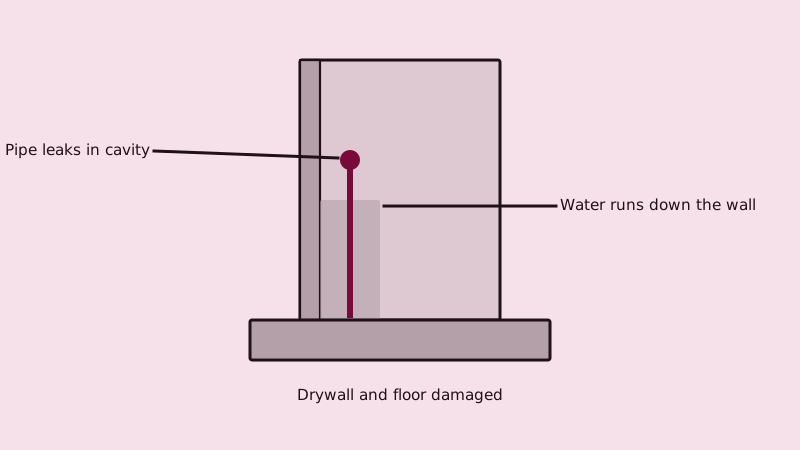
Sometimes, when symptoms are mild and leaks are isolated. A plumber can mend the failing spots while you save for the real job. The gamble is a pipe giving way inside a wall, dumping water for hours unseen, which turns the repair into drywall, insulation and flooring too.
The Plumbing Price Guide notes that partial repipes run roughly $1,000-$4,000 and suit an isolated problem, though it leans toward a full repipe when old pipe is failing throughout. If the lines are galvanized or polybutylene and a leak has already shown up, waiting rarely saves money.
When should I ask a plumber to look?
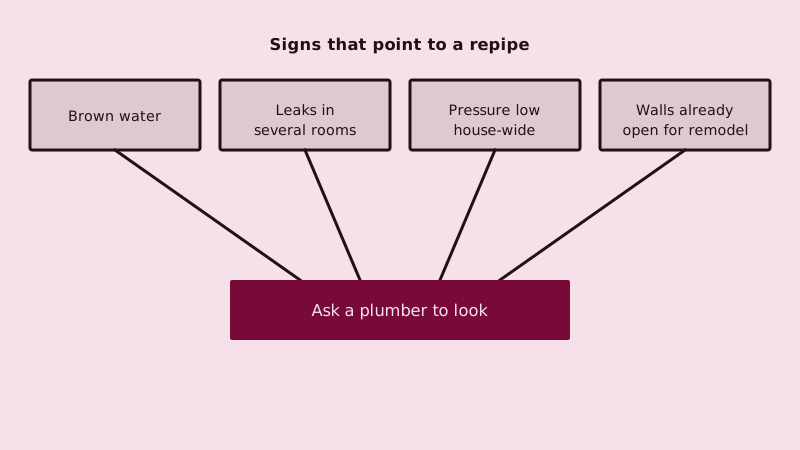
Ask when leaks keep reappearing, when water runs brown, when pressure falls house-wide, or when you are about to remodel a bath or kitchen and the walls will be open anyway. One visit lets someone name the material, test pressure and judge whether patching or replacing fits.
Start at the price request form and describe the symptoms, the house's age and, if known, what the pipes are made of. A local plumber is then lined up to visit and price the job on paper. For the bigger picture of what we do, visit the Rio Hondo Plumbing home page.
Common questions
Is there a leak count that settles it?
No magic number exists. Two or three pinholes or joint leaks in different rooms within a few years is a common tipping point, especially in copper or galvanized pipe. What a plumber wants to learn is whether the unseen pipe is as thin as the stretch that failed.
Will it add to the resale price?
It can ease a sale by retiring a known risk, and insurers may care when the old pipe is polybutylene, according to one guide. We hold no figure for resale value and will not make one up. A local agent can tell you how buyers on your street react to it.
Will I lose water pressure with new pipe?
Usually the opposite: new, clean pipe restores flow that corrosion had choked off. Pressure at the street and your regulator setting still set the ceiling, so a repipe does not raise pressure beyond what the supply delivers. The state plumbing code stops that supply pressure at 80 psi.
Can I repipe just the kitchen and bath?
Yes, that is a partial repipe, and it can suit an isolated problem. Keep in mind that new pipe connected to old galvanized steel can leave the old section as the weak link. Ask the plumber to explain exactly where the new work ends and what condition the remaining pipe is in.