Published gas line jobs mostly land between $120 and $1,350, and Bob Vila's guide gives $558 as the national average. The spread is wide because a short stub for a dryer and a trenched run to a pool heater are different projects. For the work itself, see the gas line plumber page. Here it is all about money.
How much will a new gas line set me back?
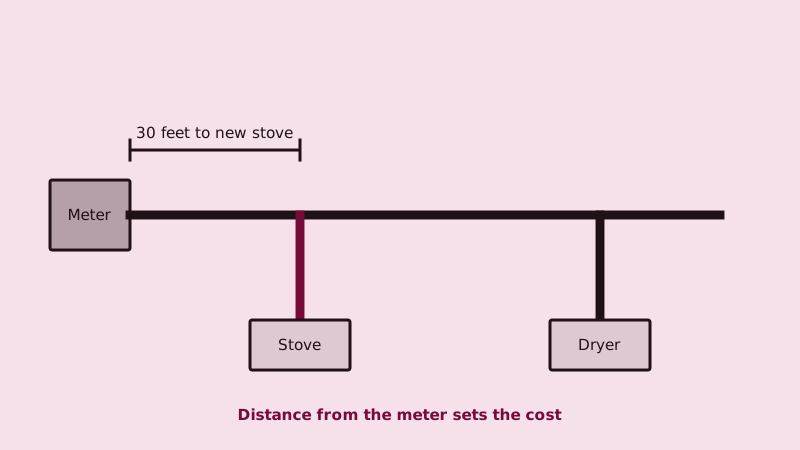
Bob Vila prices most appliance runs near $20 per linear foot, labor and materials together. Fireplaces run $15 to $25 a foot, and grills, generators and fire pits $20 to $25. As a worked example, a 30-foot line to a new stove comes to about $600. The typical installation total is $120 to $1,350.
Those are national figures. In a Whittier tract home, the length from the meter, the crawlspace access and how many appliances share the branch move your number. A fair quote names the footage, the pipe type, the permit, and who runs the pressure test, written down before a pipe gets cut. Code detail lives on the page about residential gas piping codes.
What makes a gas line cost more or less?
The distance from the meter matters most, then the route the pipe takes. Trenching runs about $4 to $12 a foot depending on depth. Pipe laid along an open crawlspace costs less than pipe fished through finished walls, and pipe on a slab house may have to travel overhead through the attic.
Gas labor follows the general plumbing band in Bob Vila's data, $45 to $200 hourly. Permit and inspection fees fill in the rest. A bigger appliance can also demand fatter pipe from the meter onward; flexible line sizing gets its own treatment on the half-inch flexible gas line page. Ask whether your existing line can carry the extra load before you count on a short, cheap run.
What does gas pipe cost per foot?
Pipe is a minor share of the bill. Per foot, Bob Vila shows PVC at the cheap end ($0.25 to $2), then copper and HDPE close behind. Stainless steel and corrugated stainless tubing (CSST) run a few dollars, galvanized steel stretches to $9, and black iron sits near $4.90.
Price is not the deciding factor, though. Which pipe is allowed is a code question that the city's permit counter answers for your job. The California Plumbing Code governs fuel gas piping, and CSST is generally installed to the manufacturer's listing and instructions. For natural gas line pipe above ground in a house, black iron and CSST are common; underground runs have their own rules.
What do gas line repairs run?
Access sets the price. Behind a stove, Bob Vila shows $120 to $250; in a crawlspace or wall, $270 to $760; and for a buried line, $1,500 up to $5,000. Swapping an old line out costs near $8 a foot, and a whole-house replacement lands in the $3,000 to $7,000 band.
Smell gas? Walk everyone out first, and skip the light switches. Once you are outside, phone the gas company, SoCalGas, on 1-800-427-2200. Dial 911 for real danger. Repair waits until the utility says the building is safe. Nobody should price a repair while a leak is active.
What about valves and connectors?
An appliance shutoff valve in Bob Vila's guide costs $100 to $300 for the part, plus labor, so the installed figure is $300 to $500. Flexible appliance connectors are cheap and normally replaced in the same visit. The guide gives no price for earthquake shutoff valves; the guide to earthquake gas shutoff valves explains what they do.
Thinking about a seismic or excess flow valve? Have it written as a separate line item, and find out if your city requires one for this job. We found no sourced price, so none is printed here.
How much are permits and inspections?
In Bob Vila's guide a permit costs $100 to $300 and an inspection $50 to $75, sometimes more than $300. Each city sets its own fees. Whittier's Building & Safety Division, (562) 567-9320, issues the permit and books inspections for gas work inside the city.
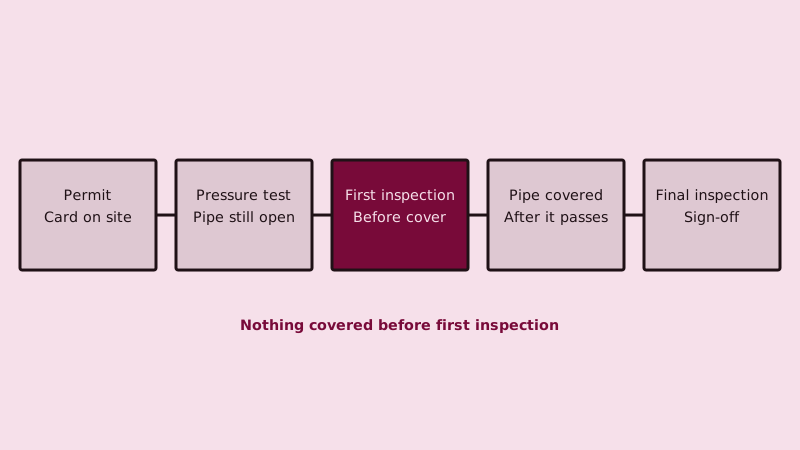
The usual steps under the California Plumbing Code are a permit for new or altered gas piping, a pressure test while the pipe is still visible, then a final inspection. Confirm the test method with your city's inspector. A line that holds pressure with no drop generally passes, and the pipe can then be covered.
Who is allowed to put in gas piping?
Gas piping needs a permit, and permit work in California is reserved to a contractor who can show a current California license. Plumbing contractors are the usual fit, and the state board can name the class for your job. A handyman without one may look cheap, but a mistake invites fire, carbon monoxide poisoning or a blast.
SoCalGas serves Whittier, Downey, Norwalk, Pico Rivera and the other southeast Los Angeles County cities we cover, and the utility, not the homeowner, normally handles its own meter. What to check before hiring is on the gas plumber requirements page; you can verify any contractor through the state board. Rates for other jobs: plumber cost.
Common questions
What will fixing a gas pipe cost?
Per Bob Vila, a stove connection within reach starts near $120 and tops out near $250. A line in a wall or crawlspace runs $270 to $760, and a buried one $1,500 to $5,000. Labor is hourly. Ask for a quote that says whether permit and pressure test are covered.
What hourly rate do gas plumbers charge?
The guide offers one broad band for gas line installers, the same as for general plumbing. Since gas work includes a permit and a test, quotes often cluster in its upper half. Many contractors price it as a flat sum, which makes bids easier to compare. Ask if the permit fee is listed apart from labor.
How long until the line is done?
A short run through an open crawlspace can take half a day; trenching stretches it. Inspection scheduling adds waiting time on top, since the pipe stays uncovered until it passes the test. Finish dates therefore depend on the city's inspection calendar as much as on the crew.
What belongs on my question list?
Collect the license number and confirm it at cslb.ca.gov. Then learn who pulls the permit, who tests the line, which pipe goes in plus whatever else the price covers. Anyone who calls a permit unnecessary for gas piping should not get the job.
Should an adult be home?
Yes. Somebody needs to point out each appliance, agree on the route and meet the inspector. Gas to the house or the branch will be off while pipe is open, so plan around cooking and hot water. If you cannot attend, name someone you trust to stand in. Send questions through the price request.
Prices are one part of the job: Rio Hondo Plumbing plumber covers the rest.