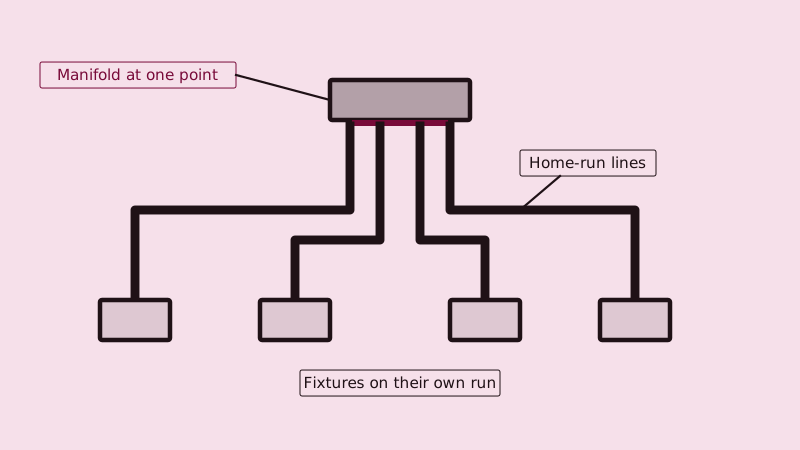
A published guide prices a house of 2,000 square feet from $4,000 up to $10,000 with PEX tubing, and between $8,000 and $18,000 with copper, before anyone patches drywall. Treat that as a yardstick only; your own house gets priced by a plumber who sees the layout. Materials and method are explained on the repiping and pipe replacement page.
What would a 2,000 sq ft house cost to repipe?
One guide lists PEX at $2 to $5 a square foot, $3 to $6 for CPVC and $4 to $9 for copper (Type L). Multiply through for a 2,000 sq ft home and PEX totals $4,000 to $10,000, CPVC at $5,000 to $12,000, and copper at $8,000 up to $18,000.
| Material | Rate per sq ft | Total, 2,000 sq ft |
|---|---|---|
| PEX | $2 to $5 | $4,000 to $10,000 |
| CPVC | $3 to $6 | $5,000 to $12,000 |
| Copper (Type L) | $4 to $9 | $8,000 to $18,000 |
Other published guides give narrower or wider bands, and none of them can see your house. Guides disagree because each assumes different fixture counts, access and patching. Disagreement is normal; it is why written quotes matter.
Labor is the bulk of it. Published guides describe labor as the largest share of a repipe. The guide above applies a West Coast labor multiplier of about 1.4 times the national baseline, which is one reason Southern California bids can drift above national averages.
And a smaller house of 1,500 sq ft?
Run the same per-foot rates against 1,500 sq ft and you get about $3,000 to $7,500 for PEX and $6,000 to $13,500 for copper, again before wall repair. That is arithmetic on published rates, not a number the source printed. Smaller houses sometimes cost more per foot, since setup work does not shrink with floor area.
Houses of about this size are common in Downey, Norwalk, Pico Rivera and Paramount; Census data show a median build year between 1957 and 1971 in those cities. Single-story layouts are easier. One guide adds 20 to 30 percent for two stories.
Count fixtures, not just feet. Published guides generally scale the price with the number of fixtures. A compact three-bath home can therefore outprice a larger house with a single bath.
Does a concrete slab change the price?
Slab homes cost more, because the new lines usually have to be rerouted overhead through attic or walls, or the concrete gets opened. The sources checked give no dollar amount for slab work, so any figure you meet is a guess. Request a quote that names the route chosen and who restores finishes.
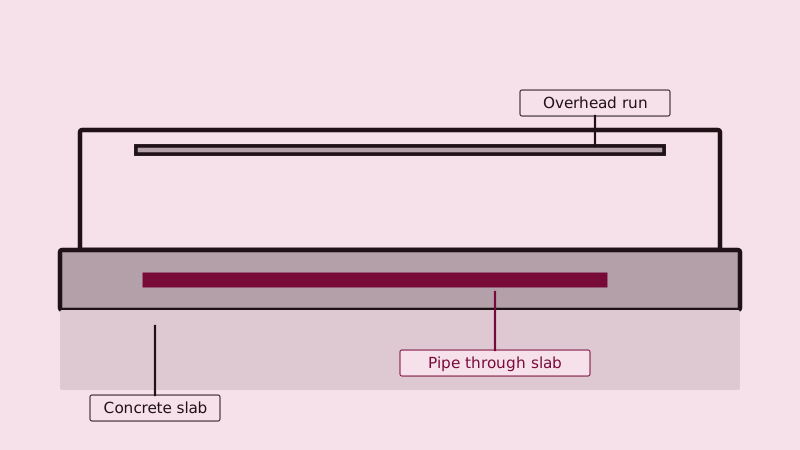
Overhead rerouting is the common answer when original lines run under concrete, since it leaves the floor intact. Opening the slab is more disruptive and tends to be reserved for one failed line. If a single leak is the whole problem, compare both paths in slab leak repair or repipe before you commit to the larger job.
How do bathrooms, stories and access change the bill?
Each additional bathroom adds roughly 15 percent in one guide, so a four-bath house runs about 45 percent above a one-bath home of the same size. A 3,000 sq ft house costs about half again as much as a 2,000 sq ft one. Begin with the 2,000 sq ft range, then scale for baths, stories and access.
| Factor | Effect (published guides) |
|---|---|
| Each added bathroom | about 15 percent more |
| Two stories | 20 to 30 percent more |
| 3,000 sq ft instead of 2,000 | about 50 percent more |
| Finished attic, tight crawl space | extra labor hours |
| Patching walls afterward | $1,500 to $3,000 in one guide |
Partial jobs follow a different logic. A single bathroom or kitchen branch is priced by fixtures and pipe run, not by house size, so a plumber must see it. Small-house and one-bath repipes sit at the bottom of the table.
The line people forget is finishing. Many quotes leave out drywall patching, texture and paint. Confirm what is in. Permits matter too: one source states that repiping needs one but names no fee, and Whittier's Building and Safety Division can be reached at (562) 567-9320 for the city's process.
Which repipe approach costs the least?
Use PEX instead of copper, repipe only the failed branch if the rest is sound, clear access to walls and attic, and line up three itemized quotes side by side. In the published ranges PEX comes in at roughly half the price of copper, and PEX is also quicker to run through walls.
- Partial scope: swap the failing section, not the whole system, where the remaining pipe passes inspection.
- Open access: empty closets and clear attic paths ahead of time.
- Finishing: patch and paint walls yourself, and ask for that line to be struck from the quote.
- Timing: rush work costs more than scheduled work.
Cheapest is not always best value. Where galvanized or polybutylene lines remain, a partial fix can leave the next failure waiting. Material trade-offs are laid out in PEX versus copper, and the question of timing in how often a house needs repiping.
Want numbers for your own address? Send a price request for a visit and a written number. California requires a contractor license for work of $1,000 or more in labor and materials, a threshold nearly every full repipe passes. The home page shows the rest of the work we arrange.
Common questions
How long is the house torn up?
A contractor guide says most whole-house repipes take three to seven days, with a small easy-access home needing only a few. Smaller, easy-access houses can finish sooner. Water goes off for stretches of each day, so stock bottled water and plan meals around a kitchen that may be dry for part of the day.
What should you ask a repipe contractor first?
Ask what pipe and route the quote assumes, whether permits and inspection are included, who restores walls, how often water will be shut off, and what the contractor warranty covers. Confirm a California license on the CSLB site (cslb.ca.gov) before signing anything.
Do you have to stay home while pipes are replaced?
Someone normally has to open the door on day one and stay reachable, because walls get cut, water gets shut off and rooms need clearing. Ask how the days will be sequenced. You do not have to hover, though decisions about where to open walls can come up midday.
Will insurance cover new pipes?
Generally policies pay for sudden water damage but not for replacing pipe that simply wore out. If a leak already damaged the house, ask your insurer what applies. For how insurers treat leaks, read slab leak coverage under homeowners insurance.
When does an old house justify a repipe?
Frequently, when lines are galvanized or polybutylene or have leaked more than once. Repeated spot repairs on failing pipe add up, while a repipe resets the whole system. A house with one leak and healthy pipe may only need a repair. Costs for that situation are in replacing plumbing in an old house.