Ideally once, and the trigger is the condition of the pipe, never a date on a wall calendar. One published guide credits PEX with 40 to 50 years, CPVC with 50 to 75 and copper with 50 to 100 or more. Galvanized steel and polybutylene are the troublemakers. Choices are laid out under repiping and pipe replacement.
Does every house need new pipes after a set number of years?
No. A copper system in good condition can outlast the people living in the house, while the same guide flags gray polybutylene, installed between 1978 and 1995, for frequent failures. Those figures come from a single cost guide. Water chemistry, operating pressure, workmanship and plain luck move them in either direction.
Read the ranges as rough orientation rather than a promise. Age counts for less than three questions: the material, the leak history, and the state of the pipe's interior. A plumber can open a small section and judge wall thickness and scale on the spot.
So a repipe is a judgment call. Plenty of owners never do one; some do it a single time. Asking because something just leaked? Read the later sections on warning signs first.
How old is the plumbing in homes around Whittier?
Census figures put the median home in Norwalk and Pico Rivera at about 1957, Downey at 1959, La Mirada at 1960, Artesia at 1966, Hacienda Heights at 1968, Paramount at 1971 and Cerritos at 1974. Pipes from a 1950s or 1960s build are now 60 to 70 years old unless someone replaced them.
Whittier's own figure is not in the data used here, so ask when your own house was built. Original plumbing in postwar tract homes was commonly galvanized steel or copper, and drain lines were often cast iron or clay. Many houses have had a mix of original and later work, so the system in your wall may be younger than the house.
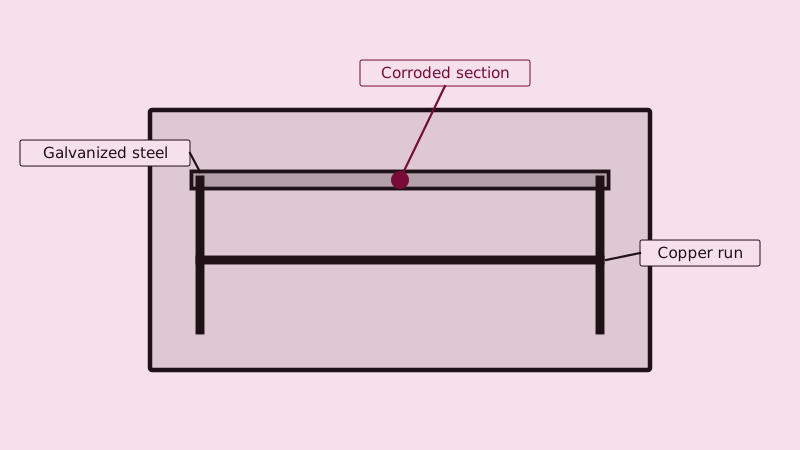
Galvanized steel rusts from within, narrows and starves fixtures of flow. Copper can develop pinhole leaks, especially where water is hard and aggressive. The city of Whittier reports average hardness of about 250 mg/L, which is hard. See galvanized pipe replacement for how that failure looks.
Which warning signs mean a repipe is due?
Look for leaks in different spots, pinholes in copper, discolored water at several taps, pressure falling at fixtures that once ran strong, stained ceilings or walls, and pipe that flakes when touched. A single leak proves little. A pattern proves a lot.
Checklist:
- More than one leak within twelve months, on separate sections.
- Blue-green stains or crust on copper joints.
- Cloudy brown or orange water when a tap first opens.
- Pressure that has dropped across the house, not at one tap.
- Polybutylene (gray plastic) supply lines, or known recalled fittings.
- A bill that keeps rising while habits stay the same.
Rule out pressure first with an inexpensive gauge. The state plumbing code caps pressure at 80 psi, and a faulty regulator can punish pipes that are otherwise fine. For a leak behind a wall, the stopgaps are described in repairing a pinhole leak in copper pipe.
Fix one section or replace everything?
A spot repair is enough when the pipe is sound and one section failed from a known cause, such as a bad joint or a nail. Replacement pays when old pipe walls are thin, leaks recur, pressure has collapsed, or a remodel already has the walls open. Compare cost against how often you are repairing.

Cost is the reason owners hesitate. One guide's range for a house of 2,000 square feet is $4,000 to $10,000 for PEX and $8,000 to $18,000 for copper, so repeated repair bills add up, but only a plumber's inspection says which way your house falls. Numbers and sources are on what repiping a house costs.
Slab homes add a wrinkle, because a failed line under concrete can be rerouted instead of dug up. Slab leak repair or repipe works through that choice, and the reasons owners give are collected in why repipe a house.
How do you prepare to hire for a repipe?
Gather two or more written bids, check each contractor's California license at cslb.ca.gov, and learn what pipe and route each bid assumes and who restores the walls. Permits are part of the process; Whittier's Building and Safety Division explains local steps on (562) 567-9320.
Request evidence: a cut section, a corrosion photo, a pressure reading. Anyone recommending a whole-house job should be able to explain why. If you are only planning ahead, an inspection now is easier than an emergency repipe after a ceiling has come down.
A price request is the starting point, and a local plumber will arrange to look. State law requires a contractor license for jobs of $1,000 or above in labor and materials. For our other services, return to the home page.
Common questions
Do copper pipes ever need replacing?
Sometimes. Copper can last many decades, but aggressive water, high pressure or poor soldering can cause pinholes. One failed section can simply be repaired, and many copper systems carry on for decades after a single fix. Pinholes that keep turning up along different runs suggest replacement.
Does PEX last as long as copper?
One guide gives PEX roughly 40 to 50 years against 50 to 100 or more for copper, though real life varies. PEX resists freezing damage and pitting, but it can be harmed by sunlight and some chemicals. Workmanship and water conditions count too.
Should I repipe before selling?
Not automatically. A known problem, such as polybutylene or galvanized lines with leaks, may come up in an inspection, and a buyer may ask for credit or repair. A plumber's report and written quote can help you decide. Compare costs before replacing anything for a sale.
Can pipes be replaced one room at a time?
Yes. Partial repipes, such as a bathroom or a kitchen branch, are common, and they spread the cost. The trade-off is that old pipe left behind can fail later, and tie-ins between old and new metals need the right fittings to avoid corrosion at the joint.
Does repiping need a permit?
In general yes. Replacing piping is plumbing work that cities regulate. Call your city's building division before work begins; whoever does the job usually pulls the permit. Whittier's Building and Safety Division lists (562) 567-9320. Other cities in the area have their own offices.