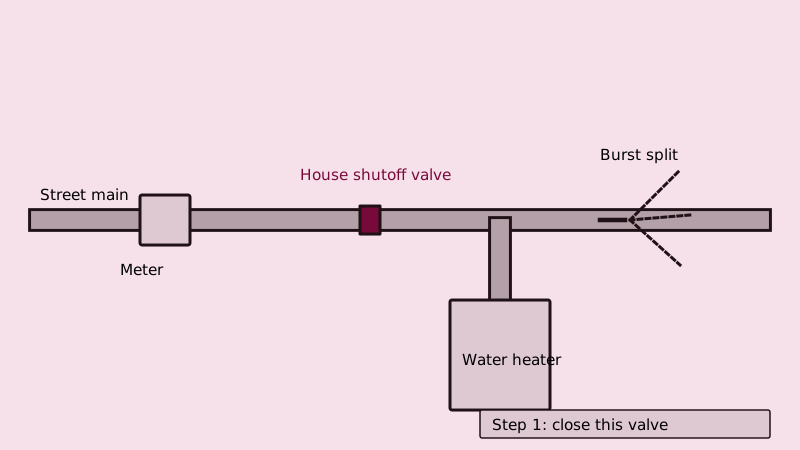
Water that keeps running is the real emergency, so cut supply at the house valve before anything else, then phone us. We'll arrange a plumber to trace the split and replace the damaged run. This is one corner of our leaks and burst pipes coverage for Whittier, Downey, Norwalk and the neighboring cities.
What stops the flood fastest?
Turn the house valve clockwise until it stops. Ball-style levers go a quarter turn, round gate handles take several. Next, open whichever spigot sits lowest and let the plumbing empty out, and flip off breakers serving any soaked room. Take phone photos before you start cleaning, because adjusters like evidence.
Where the valve hides depends on the house. In tract homes around Whittier check the front wall by the hose spigot, the garage wall near the heater, or along a side yard. A stuck valve is common on old gate types. A second stop sits in the box at the curb, but that one is the water supplier's. City of Whittier water customers reach the utility at (562) 567-9530.
A few extra moves help:
- Close the supply to the water heater too, so the tank is not feeding the break.
- Get rugs, shoes and gadgets up off soaked flooring.
- Keep clear of any ceiling that droops. A pooled bulge can let go all at once.
- Use a mop, towels and a fan, and leave drywall removal for later.
Weekday office hours: opening 9am, closing 5pm. Beyond those hours, the valve is all you have and the price request form holds your place in line.
Why do pipes burst in Southern California if it rarely freezes?
Mostly because the metal gives up. Many homes here date from the postwar boom, and American Community Survey data puts the median build year at 1959 in Downey, 1957 in Norwalk and Pico Rivera, and 1960 in La Mirada. Galvanized steel rusts shut from inside, early copper thins, and either splits when pressure surges.
Ice plays a small part. Ice needs temperatures at or under freezing for a long stretch, and Whittier seldom gets that. Rare local cases are attic runs left bare or lines near a crawl space vent. More often the culprit is household pressure past the 80 psi ceiling in the state plumbing code (CPC 608.2), a worn regulator, a water hammer slam, an earthquake shift or a tree root pushing on buried pipe.
Where do hidden splits show up, and how are they fixed?
Hidden splits announce themselves slowly: a brown ring on drywall, paint that blisters, floorboards that heat up for no reason, or a meter dial creeping around with all fixtures off. Opening the wall at the damp spot is the usual fix. The plumber removes the failed piece, sleeves in new pipe, then lets the cavity dry before patching.
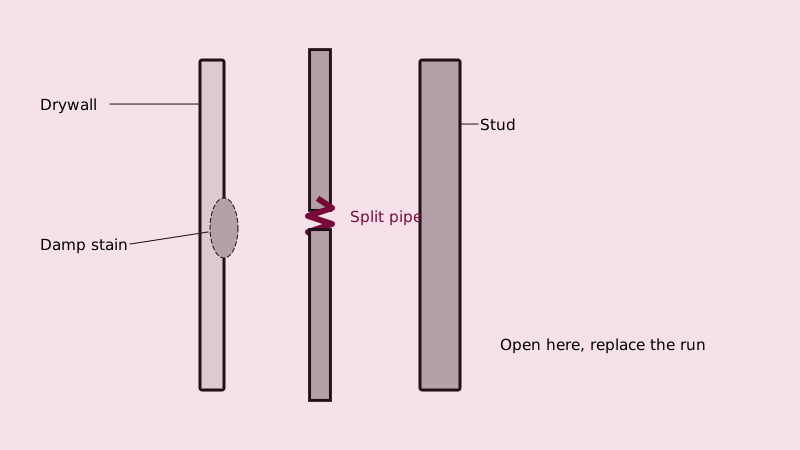
Slab leaks change the plan. A line beneath concrete is found with detection gear first. Then the choice is a tunnel or cut-out repair, or retiring that line in favor of fresh pipe through the attic. Our guides on clues that a wall pipe has split and ceiling water leaks help you read the clues before the plumber arrives.
Who pays when a water pipe bursts?
Whoever owns the building owns the problem. A homeowner covers pipes from the meter inward, while the utility looks after the street main. In a rental, Section 1941.1 of the state's Civil Code lists functioning plumbing among a rental's habitability basics, so the landlord normally repairs it. Tenants report in writing the same day.
Condos and townhomes add a wrinkle. A pipe inside a shared wall may belong to the association, one inside your unit to you, and the documents on file decide it. Ask the manager before hiring anyone. If the owner approves the visit, we'll arrange the plumber and the written quote can go to whoever is paying.
Do renters owe anything for a burst pipe?
Seldom. A rotted line or a pressure failure is the building's problem, not the tenant's. What a tenant should do is tell the landlord quickly, in writing, with photos, and close the valve if they can reach it. A tenant's own things are a matter for renters insurance, since the landlord's coverage ignores them.
Trouble starts when the tenant caused the break, say by nailing into a wall or sitting on a drip for weeks. A landlord may then ask for payment. Keep dated messages. Disputes are a legal matter that we do not handle, so a local tenant resource suits a dispute.
Will homeowners insurance cover the mess a burst pipe leaves?
Often yes for the sudden, accidental part: soaked drywall, flooring and cabinets. Policies commonly refuse the pipe itself, slow seepage over months, and flooding from outside. Your declarations page and endorsements settle it, so read yours or phone the agent before you commit to demolition.
Our separate guide to burst pipe insurance coverage lists the paperwork adjusters ask for. Meanwhile, hold on to the cut-out chunk of pipe, save each invoice, and do only what stops further loss. Let the adjuster see finished materials before they go in a dumpster.
What does an emergency burst pipe repair cost near Whittier?
Published guides give $150 to $450 for the leak repair alone and $300 to $800 for a burst pipe in another survey. Cleanup is a separate line: Bob Vila says $1,000 to $4,000 for cleanup and repairs when water spread. Treat them as a national yardstick, because only the written quote is binding.
Late-night call-outs cost more, since the guides we checked describe 1.5x to 3x the day rate, or $100 to $350 tacked on as a callout charge. We schedule in office hours, Monday to Friday, which keeps most visits at the regular rate. Before work starts you get the quote with access, parts and patching spelled out.
Cost climbs when:
- the pipe sits behind finished tile or a ceiling,
- brittle galvanized steel splits again beside the patch,
- concrete has to be cut for a slab line,
- several rooms need drying.
Is a burst sprinkler line or a bathroom pipe handled differently?
Same first move, different parts. A burst sprinkler lateral is cut and re-coupled after you close the irrigation valve, and nobody needs to tear into walls. A bathroom break tends to hide at a supply stop, a braided connector or a shower valve behind tile. In an apartment, notify the manager and use the unit valve if one exists.
True basements are scarce here. Raised foundations with crawl spaces stand in, and water can sit there unseen for weeks. When every tap is closed and you still hear flow, read the meter. Typical home leaks run past 9,300 gallons yearly according to EPA, so even a slow weep deserves a visit.
Common questions
Can you hear a burst pipe before you see it?
Listen for a hiss, a rushing noise behind the wall, a dripping ceiling or a pool where none belongs. The meter may spin with all fixtures off. No video clip is needed to confirm it. Close the valve, then call a plumber and describe where the sound seems loudest.
Can I patch a burst pipe myself?
A rubber clamp, repair sleeve or push-fit coupler can slow a small split until help arrives. Lasting repairs need a plumber. Bigger jobs and anything needing a permit fall under the state's contractor licensing law, and the CSLB site spells out the dollar threshold. Gas lines are never a DIY job.
Does a pipe repair need a permit?
Swapping a short section like for like often does not, while rerouting or replacing a big part of a system may. The City of Whittier Building and Safety Division answers permit questions at (562) 567-9320, and every neighboring city has a separate permit counter. Ask the plumber to confirm before tools come out.
Should I worry about the water heater?
Yes, a little. A split on the hot side can keep the tank refilling while water pours out. Close the cold inlet to the tank. For an empty tank, turn a gas heater's control to pilot or switch off the breaker of an electric one, then have the plumber inspect before it fires again.
Every service and price guide is on plumber across Whittier.