Published guides put a full repipe somewhere in the $4,000-$15,000 band, with pipe material swinging the figure harder than square footage. Unsure the old lines must go? The reasoning is in why people repipe a house, then return here for the mechanics, the money and the rules.
Will a clamp hold a leaking copper pipe?
For a pinhole or hairline split on a straight section, yes: a rubber-padded clamp stops the spray. Think of it as a weekend fix. Copper that pinholed once is frequently thin in other places too, so a clamp on one spot tells you nothing about what is hiding inside the wall.
Turn the supply off, wipe the pipe dry, pick a clamp sized to the outside diameter and tighten it evenly. Trouble at a fitting is different, because the clamp finds nothing to bite and the joint has to be remade. Several pinholes in separate rooms over a few years turn a patch into a repipe discussion; the question of repipe frequency is unpacked elsewhere.
What does a proper fix for damaged copper look like?
A plumber removes the bad stretch and sets in fresh pipe, joined with soldered or press-fit couplings; drinking-water solder has to be lead-free. On an exposed, accessible line that is routine. Inside a wall it means opening drywall first, so many owners ask for a repipe price at the same visit.
Repair suits an isolated failure in a system that is otherwise sound. Once the next section you uncover looks green outside or roughened inside, patching starts to look like paying twice. Some plumbers cut a sample open to inspect the bore before advising anything. For leaks under concrete, slab leak repair or repipe deals with the special case.
What lifespan can a new set of pipes promise?
None that anyone should state flatly, since life depends on material, water chemistry, pressure and workmanship. PEX and copper both have long track records, and each manufacturer publishes its own warranty. Ask whoever bids for the written terms of the exact product they would install.
Two local variables deserve a look. Whittier's city water system averaged 250 mg/L total hardness in its 2025 consumer confidence report, near 14.6 grains per gallon, and water that hard leaves scale behind. Pressure counts as well. The state's code puts the cap at 80 psi (608.2), and new pipe fed by a house sitting near 110 psi begins life under strain. A regulator is cheap protection on any repipe.
How disruptive is a repipe?
It is one of the messier jobs in residential plumbing, though not the most technical. Lines run through walls, ceilings and sometimes concrete, so the crew opens drywall in many small spots, pulls the old pipe, runs new, pressure tests and reconnects each fixture. Access and wall repair create most of the difficulty.
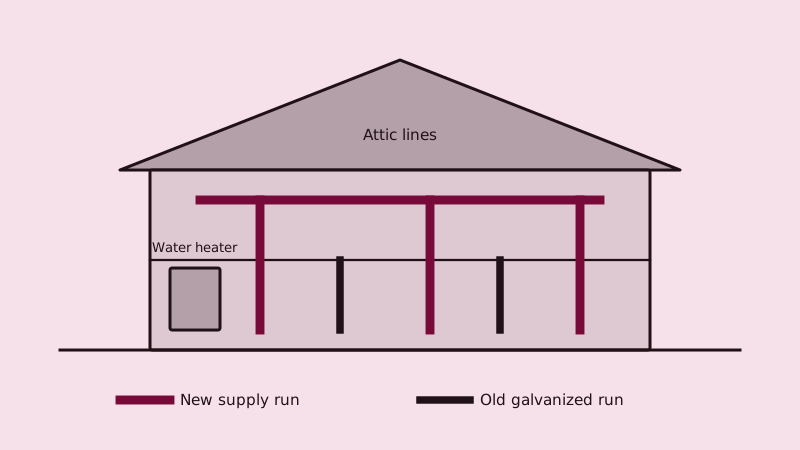
Working in a one-level house with attic access is easier than in two stories, and pipe cast into concrete is harder yet. Tile and finished walls slow everything. PEX flexes through bends and needs fewer joints, so it often goes in with fewer openings than stiff copper would.
Homes in Downey, Norwalk, Pico Rivera and La Mirada have median build years between 1957 and 1960 in Census data, which makes original galvanized steel or early copper plausible. Both materials get their own notes: see swapping out galvanized lines and replacing polybutylene.
What does a larger home, say 2,000 sq ft, run?
One guide sorts repipes by bathroom count. Its three-bath tier, which covers houses from 1,800 up to 2,500 sq ft, shows $6,000-$10,000 in PEX against $8,000-$15,000 in copper. Because it keys on bathrooms, a house that size with fewer baths could land lower. National benchmarks only.
The same source gives whole-house ranges of $4,000-$10,000 for PEX, $6,000-$15,000-plus for copper and $4,500-$11,000 for CPVC. Bob Vila offers a wider $1,500-$15,000 spread with a $7,500 average. A bid for your actual house beats any table.
Check what each bid leaves out. Drywall repair and paint can add $1,000-$3,000, permits run $100-$400 depending on the city, and every extra fixture hookup can add $200-$500. Longer breakdowns live in the repipe cost and PEX pricing pages.
What signs say the old pipes are finished?
Look for leaks turning up in several rooms, pressure sagging across the whole house, rusty or brown water, or galvanized steel and polybutylene somewhere in the system. A lone leak rarely justifies a repipe on its own. A pattern of them usually does, and the cost of waiting is water damage.
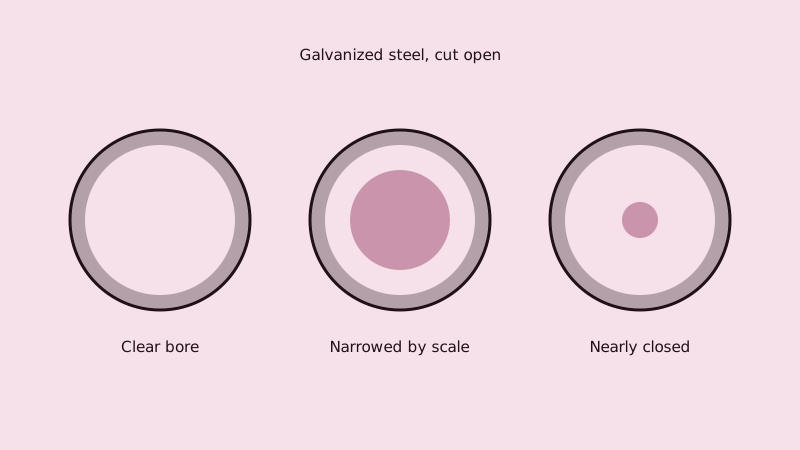
Brown water after the house sits idle, crusty fittings and a weak trickle at the farthest bathroom are the standard signs of galvanized pipe closing up inside. Polybutylene is a gray or blue plastic used decades ago, and some insurers raise questions about it. A plumber can often judge the pipe at the meter, water heater and under sinks without cutting anything open.
Is it money well spent?
When the system is failing, normally yes, because each patch costs money and the water damage behind it costs more. When the lines are sound, no. Set the price against what you keep spending on repairs, the risk of a soaked ceiling and how long you intend to keep the house.
A partial repipe for one troubled zone runs roughly $1,000-$4,000 in the guide, though the same guide leans toward a full job when old pipe is failing everywhere, since a partial leaves tired pipe in place. Pairing a repipe with a remodel or a water heater swap means walls get opened once instead of twice.
Could I do my own repipe?
The law decides that before skill does. A repipe is permit work, and State law sets a $1,000 line, counting labor and materials together, above which a contractor license is mandatory, and permit work is covered whatever it costs. Whether an owner may pull a permit personally is for the city to answer.
Even where an owner is allowed, a single failed joint in a wall cavity can soak a house overnight. Homeowners who save money on repipes generally do it by handling drywall patching and painting separately, which the guide budgets at $1,000-$3,000 for a drywall contractor. For Whittier addresses, call the city building department; each neighboring city runs its own.
How long are the taps off during a repipe?
A standard house takes two to five days overall. A compact home with open access can wrap up in around two, while a big one with pipe inside finished walls may stretch to a week, per the Plumbing Price Guide. Wall repair follows. Plan on dry taps for long stretches each day.
Plan for daytime without water: somewhere to wash, a cooler for food, clear paths to the water heater, closets and under-sink cabinets. Those day counts assume materials are on site and the permit is already issued.
So which material should go in?
For most single-family homes, PEX is the practical pick when speed and a smaller wall-opening count matter, and copper fits owners who want it and budget for it. Either needs a pressure regulator and proper support. Decide after someone has seen the access, not before.
A side-by-side comparison is on PEX versus copper, and the sequence of steps is in the step-by-step repipe walkthrough. Want someone local to take a look? Send Rio Hondo Plumbing photos of the water heater and meter area and we'll arrange it.
Common questions
And a smaller 1,500 sq ft place?
For a 2-bath home between 1,200 and 1,800 sq ft, the Plumbing Price Guide shows PEX at $4,000-$7,500 and copper at $6,000-$11,000. Bob Vila prints a lower $2,280-$5,120 for a 3-bedroom house of about 1,500 sq ft. With a gap that wide, collect several quotes before you decide what your house should cost.
Does a slab foundation raise the price?
It is the costliest case, though the guides print no separate figure, since lines must be routed up through walls or across the attic. Rather than breaking concrete, plumbers usually retire the slab lines and send new pipe overhead. Ask for the planned route and how many wall openings it needs.
What is the least expensive approach?
Choose PEX over copper, which the guide credits with 30-40 percent savings. Gather three bids, split out drywall and paint, book in spring or fall, and bundle with a remodel. For an isolated problem a partial repipe may do, at about $1,000-$4,000.
Should I choose PEX or copper?
No single winner exists. PEX is the cheaper option, goes in quickly and snakes around corners with few joints. Copper is stiff, proven across a long record, pricier and slower. Budget, access and taste settle it. Compare them further on PEX versus copper.
What does the 135 rule refer to?
We found no California Plumbing Code rule going by that title, and a made-up meaning would not help you. Different people stretch the phrase over different things. When a contractor says it, ask which section is meant. The supply-line figure you will really meet is 80 psi.
In this section
- Galvanized pipe replacement
Recognize galvanized steel supply pipe, learn why it fails, what replacing it involves, how long it takes, whether it needs a permit, and…
- Repiping and pipe replacement
There is no fixed repipe date. Pipe material, age, water and the leak record decide it.
- Repiping and pipe replacement
How a complete house repipe works from first walkthrough to final test: PEX or copper, slab homes, the permit, the mess, and what it costs…
- Repiping
A PEX repipe runs about $4,000 to $10,000 in national guides, with copper higher.
- Repiping and pipe replacement
PEX or copper for a Whittier repipe? Cost drivers, flow, lifespan, cold weather, fittings and what California code allows, with a written…
- Polybutylene pipe replacement
Polybutylene pipe is known for leaks and no longer meets US plumbing codes.
- Costs
What repiping a house costs: PEX versus copper, 1,500 and 2,000 sq ft homes, slab jobs, wall repair and ways to trim a quote.
- Repiping
Failing galvanized steel, polybutylene, pinholing copper or falling pressure are the usual reasons to repipe.