A puddle by the dishwasher, a brown bloom on the ceiling, a meter dial that creeps while the house sits empty: every one of these starts with the same move, stopping the supply. After that comes the question of where the water is going and who should chase it. This page covers both for homes in Whittier, Downey, Norwalk, Pico Rivera and the neighboring cities of southeast Los Angeles County. Use the price request form when you are ready to book a visit.
What should I shut off first when a pipe is leaking?
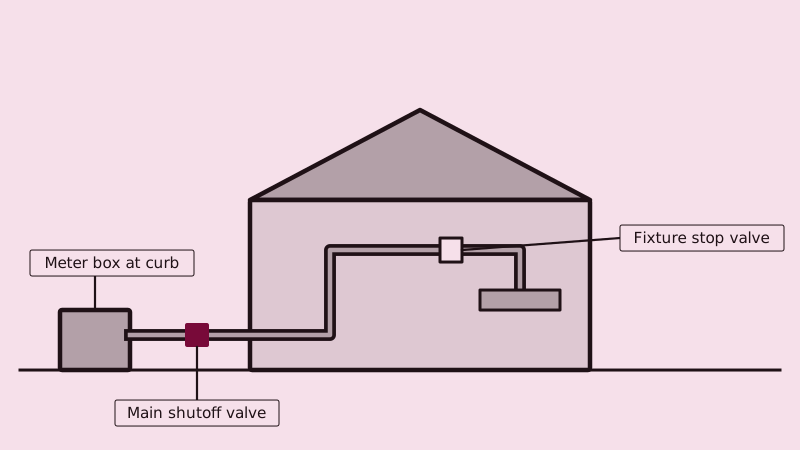
Turn the main valve to closed. The valve sits where the service line reaches the house, usually low on the front wall, or in the box at the curb that holds the meter. Afterward, crack the lowest spigot you have and let the pipes drain. One misbehaving fixture needs only its own stop, the small oval handle beneath the basin or beside the toilet base.
Practice the motion once while nothing is wrong. Houses built around the late 1950s, which is the median build year the Census reports for Downey (1959), Norwalk and Pico Rivera (both 1957), frequently keep their first gate valve, and that style of valve can seize or fail to seat. If yours spins without stopping the flow, the meter box valve belongs to the water provider and can be closed as a fallback, while a replacement house valve is a small job to ask a plumber to price.
Electricity comes second. If water is running toward an outlet, a ceiling fixture or the panel, kill that circuit at the panel, but only if you can walk to the panel on dry floor. If not, back away and phone 911.
Where is the water going when no fixture is leaking?
Start with the meter. Close every tap, pause the dishwasher and the icemaker, write down the dial reading, then leave the house alone for two hours. EPA describes this same check. If the dial has moved when you return, water is escaping somewhere out of sight, and the job becomes pinning down where.
These clues help:
- Tint each toilet tank with food coloring. If tint shows in the bowl ten minutes later and nobody flushed, that flapper is guilty.
- Tile that feels warm under bare feet in a slab house, which may mean a hot line is failing beneath it.
- A damp, earthy smell in a closet or cabinet with no visible water.
- A faint hiss after bedtime, strongest by the water heater or the front wall.
- A January bill that reads like July. EPA flags a four-person household passing 12,000 gallons during a cold month.
Pinpointing the spot generally needs equipment homeowners lack: acoustic sensors, or pressure tests that isolate one run at a time. What those visits involve is laid out in what leak detection costs, and a high bill with nothing visibly wrong follows one example from meter to cause.
Who can come out fast for an active leak?
Our lines are open weekdays, 9am to 5pm. Call then and we begin arranging a visit by a local plumber. We cannot promise an arrival time, since that hinges on who has an opening. Outside those hours, stopping the water is your part, and a stopped leak can wait for morning.
Tell us the address, what you can see, and whether the supply is off, and that is enough to start. A running flow, a ceiling letting water through, or wet electrical gear counts as urgent. Splits in a line have a page of their own, urgent help when a line has split. A slow drip below a basin seldom justifies a rush call, and a next-day slot costs less.
Which leaks turn up most often in homes like yours?
The commonest leaks are the dull ones: a worn toilet flapper, a faucet that drips, a valve that weeps at its stem. EPA's national estimate is that a typical household leaks away more than 9,300 gallons a year, while about nine percent of homes lose 50 gallons or more every day.
Inside the walls and floors, the picture changes by location:
| Location | Usual culprit |
|---|---|
| Beneath a sink | A cracked supply line, a loose nut, a drain slip joint |
| At the water heater | A rusted tank, a dripping relief valve, a seeping top fitting |
| Inside a wall | Pinholes in aging copper, joint failures, corroded galvanized steel |
| Under a slab | Corrosion or rubbing on lines that run through concrete |
| In the yard | Hose bibs, sprinkler fittings, the buried run from the meter to the wall |
In the older blocks around central Whittier and the postwar tracts nearby, galvanized and copper supply lines sit beside cast iron or clay drains. Those materials age on a similar clock, which makes a first leak a likely preview. Two pinholes in the same year is a signal to ask the plumber about the whole run. Related guides: repairing a leaking pipe and pinholes in copper.
Which clamps actually hold a leaking pipe?
A rubber-lined repair clamp matched to the pipe's outer diameter is the usual stopgap. Silicone self-fusing tape and a push-fit coupling are the other two. All three hold a small leak for a short time, so plan a proper repair soon after.
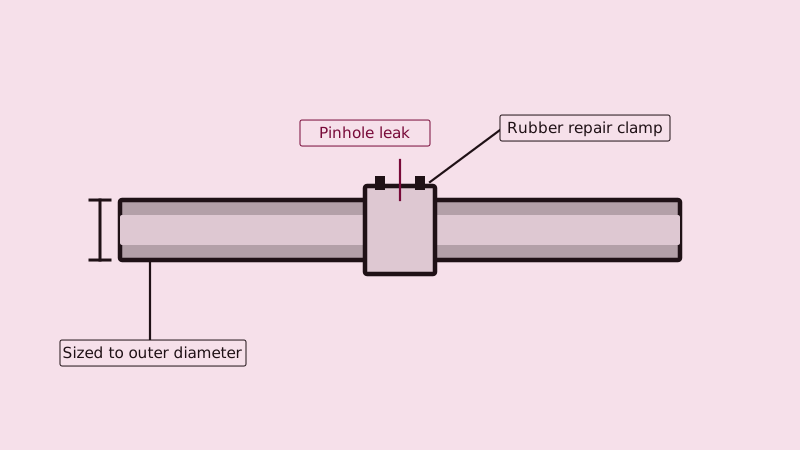
Sizing trips people up: copper, PEX, PVC and galvanized steel measure differently at the same nominal size, so check the printed range on the clamp. A clamp does nothing for a corroded stretch, because the metal beneath keeps thinning, and it will not close a joint that has pulled apart under pressure. Plastic lines have separate options, covered under stopping a plastic pipe leak. A weeping joint is its own case, discussed in fixing a leaking pipe joint.
How do you patch a leaking copper pipe quickly?
Drain the run, towel the tube dry, saw out the bad stretch with square cuts, and slip a push-fit coupling onto the clean ends. No torch, no solder. That is the fastest lasting fix a homeowner can do. A clamp can hold a pinhole in the meantime.
Prep decides whether it lasts. Remove the burr, wipe off scale, and make sure the tube is round, because push-fit couplings leak on dented or rough copper. If the wall of the tube is thin along the whole run, a patch buys weeks, and a plumber may propose replacing the length or planning a repipe. The repair versus repipe decision for slab leaks explains how that choice gets made.
Mind the law as well. State law draws a line: you need a contractor license once labor plus materials hit $1,000, or whenever a permit is involved. A small patch falls under that line. A larger replacement does not.
Can the air conditioner keep running with a leak overhead?
Switch the system off at the thermostat when water drips from a ceiling, a vent or the air handler. Trip its breaker too, where that is safe. The water may be a plumbing leak, or it may be the system's own condensate line, and either way running it spreads moisture into wiring and insulation.
Never touch switches or cords with wet hands or wet feet. A ceiling bellied out with trapped water can be drained by puncturing the lowest point above a bucket, provided you stay away from light fixtures and wiring. Next steps for a stained or sagging ceiling are in ceiling water leaks.
How often do pipes actually burst around here?
Freezing bursts are rare around Whittier, where hard freezes hardly ever happen. The bursts that do occur trace to corrosion, failed fittings, excess water pressure, or a pipe past its working life. No local count supports this, so read it as a pattern rather than a statistic.
Pressure deserves attention. The California Plumbing Code caps static pressure at 80 psi, yet a regulator that has stuck open can overpressure a house for years without a sign. Banging pipes and toilets that keep refilling are hints. The fix is covered in swapping out a failed pressure regulator. For the wider picture, try causes of pipe failure and ways to prevent a burst.
What will fixing a leak cost, and what else is involved?
The plumber names a price only after seeing the leak, and the number reaches you on paper before any tool comes out. A fixture repair is brief. A wall leak adds cutting and patching. A leak under concrete can mean tunneling or running new lines overhead. We print no figure here because we have no sourced number for this job, and slab leak repair cost gives a better guide.
Permits depend on scope. For piping replacement beyond a simple patch, call the City of Whittier Building and Safety Division at (562) 567-9320 or the building office in your own city. After a large loss, phone your insurer before cleanup begins and read about drying out after a pipe lets go. Everything else we arrange is listed on the home page.
Common questions
Who is responsible for a burst water pipe?
Whatever lies downstream of the water meter belongs to the owner, while the provider looks after the main up to the meter. For a rental, Civil Code section 1941.1 names working plumbing as a habitability standard, which puts repairs on the landlord, with an exception where the tenant did the damage. A written report with a kept copy protects you.
Does homeowners insurance cover water damage from a burst pipe?
A lot of policies cover the damage from an abrupt burst but not from a slow seep or ordinary wear, and cover for the broken pipe itself differs between insurers. Check your policy wording or phone the insurer, and photograph the scene first. Questions worth asking are collected in what insurers say about burst pipes.
Are renters responsible if pipes burst?
Usually not. A tenant answers for damage they cause, and a pipe that fails through age is the landlord's repair. Still, close the supply, put the report to the landlord in writing, and ask a renters insurer about your belongings. Lift valuables clear of the wet area and take dated photographs.
How bad is a burst pipe in a house?
That depends on how long it runs and where. A split behind a sink floods a cabinet. A break on a pressurized line in a wall or attic can soak a large part of a house before anyone notices. The shut-off takes seconds, but drying framing and drywall takes days, and wet materials left too long invite mold.
How much does a plumber charge for a busted pipe?
Price follows access, pipe material and how much wall, tile or flooring must come out. Mending an exposed pipe is cheap. Mending one entombed in tile or concrete is a different bill. Get the number on paper. Contracts above $500 must be written under California rules, and labor and materials belong on separate lines.
In this section
- Burst pipe prevention
Whittier homes rarely freeze, yet pipes still burst.
- Burst water pipe
A burst water pipe plan for Whittier-area homes: first five minutes, who owns which pipe, documenting damage, getting a plumber and what…
- Ceiling water leak
Water coming through the ceiling? Steps to take in the first minutes, how to tell a plumbing leak from a roof leak, mold timing, apartment…
- Leaks and burst pipes
Homeowners policies often treat sudden leaks and slow leaks differently.
- Leaks and burst pipes
Homeowners policies often pay for sudden pipe bursts but not for slow leaks or the pipe itself.
- Leaks and burst pipes
Burst pipe in Whittier? Stop the flow, learn who pays, what insurance may cover, and how we arrange a plumber to repair it with a written…
- High water bill no
A high water bill with nothing dripping often means a hidden leak.
- Leaks
Identify the joint type, stop the water, then fix it: tighten, re-seal, replace a coupling or call a plumber.
- Leaks and burst pipes
Signs a pipe has burst, a meter test that settles it, how to check beneath the floor, and what to do the minute you are sure.
- Leaks and burst pipes
A pinhole leak in copper pipe can be slowed with a clamp or epoxy, but the lasting fix is a cut-out repair.
- Leaks and burst pipes
A leaking water pipe: what to shut off first, temporary fixes that hold, when a plumber has to cut out the pipe, and what repairs can cost.
- Plumber leak detection cost
What finding a hidden water leak costs, what repairing it costs, and how location changes both.
- Slab leak repair companies
Picking a slab leak repair company: how a good detection visit works, the three repair routes, published prices, insurance questions and…
- Costs
Slab leak and burst pipe repair prices from national guides, what pushes a job up or down, and how to read a Whittier quote line by line.
- Leaks and burst pipes
Slab leak or full repipe? How leaks under a concrete floor are found, the three ways to fix them, what drives the cost and when a permit…
- Water damage from burst
What to do in the first hour, first day and first week after a pipe bursts: stopping the water, drying in time, who to call, and what the…
- Leaks and burst pipes
Why pipes burst in Southern California homes: pressure, corrosion, age, shifting soil and the rare freeze.