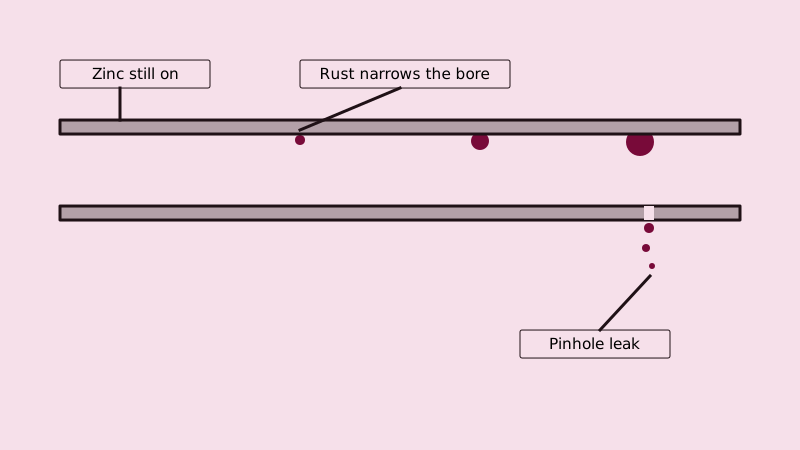
A zinc skin over steel is what "galvanized" means. Once water wears the zinc away, the steel rusts from within, flakes, chokes the bore and finally pinholes. A failing line rarely stops at one patch, and swapping the whole run tends to be the durable answer. The repipe house page describes the job, and the home page is where a request for a visit starts.
How can you tell whether your house has galvanized pipe?
Gray, threaded and magnetic: that is galvanized supply pipe. Copper is reddish brown, and plastic is white, tan, red or blue. Check under sinks, beside the heater and at the point of entry. Scratch lightly; silver-gray metal under a magnet that clings confirms steel.
Other clues:
- Brown water on first opening a tap, worst after the house sat empty.
- Strong pressure at the meter yet a feeble flow at the fixtures, declining over the years.
- Reddish stains around joints and white or orange crust at fittings.
- A house old enough for it. Census data give a median build year of 1957 in Norwalk and Pico Rivera, and I do not have a verified Whittier figure, so check your own pipe rather than assume.
If you find a mix, such as copper sections spliced into old steel, ask the plumber to note where each type starts.
Why does galvanized pipe fail from the inside?
Zinc guards the steel only until water strips it. After that, rust accumulates, the opening shrinks and flakes break loose. Flow falls, the water browns and corrosion finally eats through as pinholes. Thumbtack describes the same sequence: corrosion, rusty and bad-tasting water, blockages that cut pressure, then leaks.
Hard water adds scale on top of the rust. Whittier's city water averages about 250 mg/L total hardness in its 2025 report, so deposits can narrow pipes further. Old threaded fittings seize and can snap when turned, so a plumber may warn that disturbing the line triggers fresh leaks nearby. That is the familiar pattern of one repair, then another leak a few feet along. Pressure complaints are covered in low water pressure.
Patch or replace?
One leak you can reach, where the pipe around it is still good, can be mended. Rusty water, sinking pressure or a second leak tilt the decision toward replacing the run or the entire system. A patch is cheaper today, but every later leak brings another bill and another hole in a wall.
Request a look at the bore of a cut piece; one mostly plugged with rust settles the question. Replacing only one bathroom or the kitchen run can work when the rest tests sound. Bids are built as described in the price of replacing old plumbing.
Can you clamp a copper pipe?
A repair clamp or sleeve will stop a small leak on copper, though for most people it is a stopgap. Clamps need clean, round pipe and fresh rubber, and heat and pressure can defeat them. Treat one as time bought before the section is replaced; it is no help on corroded or out-of-round pipe.
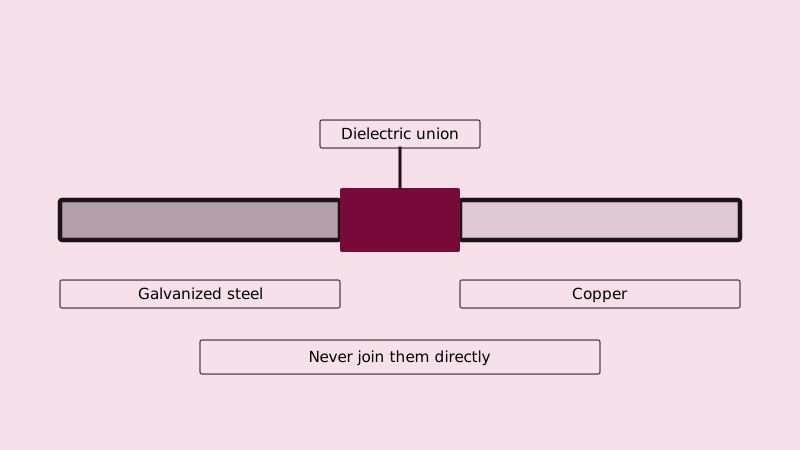
Never join copper straight to galvanized steel. Different metals set up galvanic corrosion and the joint fails early; plumbers use a dielectric union or fitting between them. When a copper repair sits next to old steel, that detail matters. Patches are detailed in pinhole leaks in copper and a weeping joint.
Can you repair damaged copper pipe?
Yes. A plumber takes out the bad stretch and fills the gap with new pipe, held by solder, a crimped press fitting or a push-in coupling. Do-it-yourself fittings are sold, but success depends on clean cuts and a dry pipe. A scatter of pinholes usually says the whole run is tiring.
Whether to try it yourself is your call. With an exposed pipe, some homeowners can close the main, drain the line and fit a push coupling. Gas pipes, main lines and anything under permit belong to a contractor. Pinholes in two places justify a repipe quote over repeated patches.
What are the timeline and permit rules for a repipe?
Thumbtack's range for a whole house is three to five days, and about four at 2,200 square feet. The work is permitted. In Whittier, permits run through the Building & Safety Division, (562) 567-9320. Ask the plumber how long the water will be off each day and what the schedule looks like.
The replacement supply is PEX or copper, each with merits (PEX versus copper). Published unit prices run about $450 to $1,000 or more per fixture, with pipe alone around 40 cents to $2 per foot for PEX against $2.50 to $10 for copper. Treat them as national averages that your own quote will move away from. More in repipe pricing and PEX repipe cost; ask as well who takes out the permit.
What about polybutylene and other old pipe?
Polybutylene, a gray plastic, went into some houses long ago and has with its own failure history and no connection to the steel problem. A current replacement program could not be verified, so none is claimed. The polybutylene pipe page has more, and the same permit rules apply.
Lead pipe or solder in very old plumbing is a health question for your water supplier and public health agencies, so ask the supplier about testing. A plumber can identify the materials and mark which sections should go. Check the contractor's license on cslb.ca.gov, and hold out for a paper estimate.
Common questions
How many years does galvanized pipe last?
No single figure applies, since water chemistry, wall thickness and household use all differ, and I will not quote one without a source. Houses with decades-old galvanized pipe commonly show rust, low pressure and leaks. The pipe's own condition is the guide, not the calendar, so cut a sample and look inside.
Which questions should a homeowner raise first?
Begin with the license number and the new pipe's material and brand. Then confirm fixture and wall-opening counts, who patches and paints, who files the permit and how the warranty reads. A written contract with a schedule, set beside a second itemized bid, finishes the job of comparing.
Is it necessary to stay in the house?
Be home on the first morning, to show where the shutoff is and which rooms are involved, and be reachable for questions and the inspector. All-day presence is not required, but prepare for water-off periods, noise and dust, and move pets and valuables clear.
Can I just replace the leaking section?
Sometimes. When the remaining pipe looks clean inside, a section can be replaced with a dielectric fitting at each transition. If the pipe is thick with rust, the next leak is coming and replacing more of it now saves wall openings later. A plumber's camera or a cut sample settles it.
Is it safe to drink water from galvanized pipes?
Rusty water is mostly an appearance and taste issue, but galvanized pipe in very old homes may be connected to other materials such as lead solder or lead service lines. Ask your water supplier about lead testing, and flush a tap that has sat unused. I am not a medical source, so ask the supplier or health department about concerns.
References
- Thumbtack, pipe installation cost (galvanized corrosion, repipe duration, per-fixture and per-foot figures; read November 2026)
- US Census ACS 2024 5-year housing data (median year built)
- City of Whittier Building & Safety Division
- City of Whittier 2025 Consumer Confidence Report (hardness)
- California Contractors State License Board