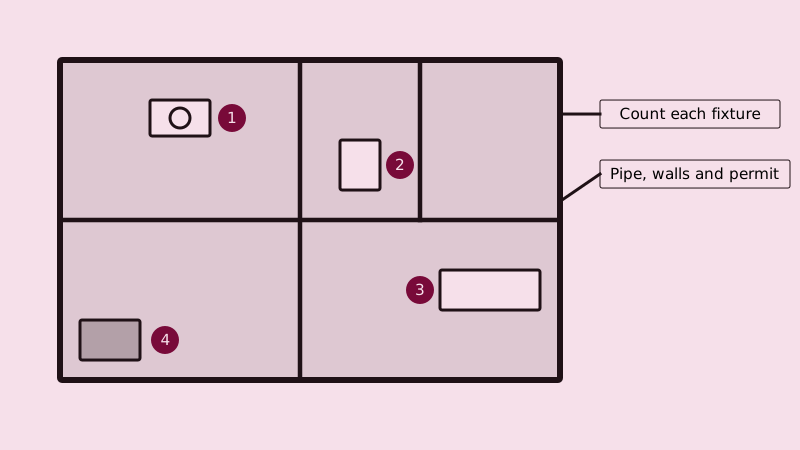
Nobody can price your old house without looking at it, but the pieces are knowable. Published guide figures run $450 to $1,000 or more per fixture, while Thumbtack says a repipe of the entire house runs three to five days. Count the fixtures, multiply, then add wall repair and a permit. Visits are set up through the home page; for the repipe alone, there is a separate repipe cost guide.
How is the cost of replacing old plumbing worked out?
Plumbers commonly bid by the fixture: each sink, toilet, tub, shower and hookup counts. Thumbtack reports about $450 to $1,000 or more per fixture, depending on whether it is a rough-in or a full hookup. Pipe alone, labor aside, is quoted for PEX, at roughly $0.40 up to $2 per linear foot and $2.50 to $10 in copper. Treat all of it as national data and nothing like a Whittier quote.
A worked example to show the arithmetic: a house with eight fixtures would come to roughly $3,600 to $8,000 at those per-fixture rates, before wall patching and permit costs. That is only arithmetic on a published unit price, and your quote could land outside it. Houses with galvanized steel, hidden runs or a second story tend to land higher.
| Cost piece | What to ask |
|---|---|
| Fixtures and connections | How many are counted, and what is included |
| Pipe material | PEX, copper or something else, and its warranty |
| Wall and ceiling opening | How many openings, and who repairs them |
| Painting and finish | Often excluded; ask |
| Permit and inspection | Who pays, and who schedules |
| Water off time | How long the house is without service |
Which parts of an old house's plumbing actually get replaced?
Most jobs mean the water supply lines, the pipes that bring pressurized water to each fixture. Drains and vents are separate and usually stay unless they have failed. Gas piping is separate again and is regulated work. A "replumb" can include any mix, so insist the quote says exactly which systems are in and out.
Typical split:
- Supply lines: galvanized, old copper or polybutylene, replaced with PEX or copper. This is the usual repipe.
- Drain lines: older homes may have cast iron or clay, swapped out only if cracked, root-choked or sagging. A camera inspection reveals which.
- Fixtures and valves: shutoff stops, faucets and sometimes the water heater connections, often replaced while the walls are open.
- Gas lines: a different trade, a different permit.
For the galvanized case, read galvanized pipe replacement; for polybutylene, polybutylene pipe replacement.
What do the older homes around Whittier have behind the walls?
Many postwar tract houses nearby carry pipe from that era. Census data put the median home build year at 1957 in Norwalk and Pico Rivera and 1959 in Downey, so expect galvanized steel or early copper feeding the fixtures, and cast iron or clay taking the waste out, house by house. I do not have a verified median for Whittier itself, though older housing is concentrated near the center of town.
Houses that old may have had repairs, partial repipes or mixed materials. Copper joints soldered before the late 1980s may contain lead solder, and I would ask a plumber and the water supplier about testing before and after any work. Whittier's water is hard (about 250 mg/L total hardness in the city's 2025 report), which can shorten the life of fixtures and pipe. See how often a house should be repiped.
How long does it take, and what happens to your water?
For a 2,200 square foot house Thumbtack's figure is about four days, within a general range of three to five. Of that, piping takes one to three days, wall repair another one to two and the city inspector a couple of hours. Taps will run dry for a stretch on each working day, and dust and noise come with it.
Get a schedule that shows the shutoff periods, any temporary supply and the dates for patching and paint. Photograph the walls before work starts. If you have a heater leak or no hot water on top of this, the heater connections can sometimes be done in the same visit.
What makes the price jump?
Access, finish work and hazards. A ranch house with attic access costs less to open up than a two-story with plaster walls, a slab foundation and cramped chases. Each wall opening needs patching and paint, and the finish is often priced separately. Asbestos in old plaster, texture, flooring or pipe wrap can add testing and abatement before work begins.

More factors:
- Pipe material you pick. PEX is faster to install than copper, which affects labor. See PEX versus copper.
- Slab construction. Rerouting avoids breaking concrete but adds wall work.
- Number of bathrooms and kitchens. More fixtures, more cost.
- Permit and inspection. City permits are required for repiping, and Whittier's Building & Safety Division answers at (562) 567-9320.
- Parking, access and phasing. Doing the work in stages can change the price.
How can you tell whether a repipe quote is fair?
Hand every bidder an identical scope sheet: material, fixture and valve count, wall openings, who patches and paints, the permit owner and the warranty terms. Compare totals only after checking what each bid omits. A bid without patching is not really the lowest.
California licensing covers permit work plus any job at or above $1,000, plus a written contract over $500; check numbers at cslb.ca.gov. Deposits have a cap as well, roughly one tenth of the price or $1,000, whichever is lower, and the board can say what applies now. A quote request begins at the price request page. On method and motives, try repiping step by step and the case for repiping.
Common questions
What timeline is realistic?
Published guidance says three to five days for the whole house, with four typical at 2,200 square feet, though plaster walls, cramped attics, slab foundations and second stories lengthen that, and patching and paint may come after, so get dates on paper.
Which questions matter before signing?
Open with the license number and the precise scope: material, fixture count, wall repair and permit responsibility. Then request a written contract with payments tied to finished stages. Two bids that itemize the same things tell you more than two bare totals.
Must you stay home for all of it?
Not all day. Still, an adult should be present on the first morning to show the shutoffs and the rooms involved, and reachable for questions and the inspector's visit. Move pets and valuables out of the work zone, and line up somewhere to wash up.
Can one bathroom be done alone?
Yes. A partial repipe replaces the worst section, such as one bathroom group or the run under a slab. The risk is that the old pipe keeps failing elsewhere, so ask the plumber to inspect and tell you how much of the system looks sound. Partial work often costs less now and more later.
Will new plumbing change my home insurance or resale value?
It can help with both, but I do not have a verified figure for either. Some insurers ask what the plumbing is made of and how old it is, and buyers' inspectors tend to flag galvanized pipe. File the permit, invoice and warranty away, and ask your insurance company what proof it wants.