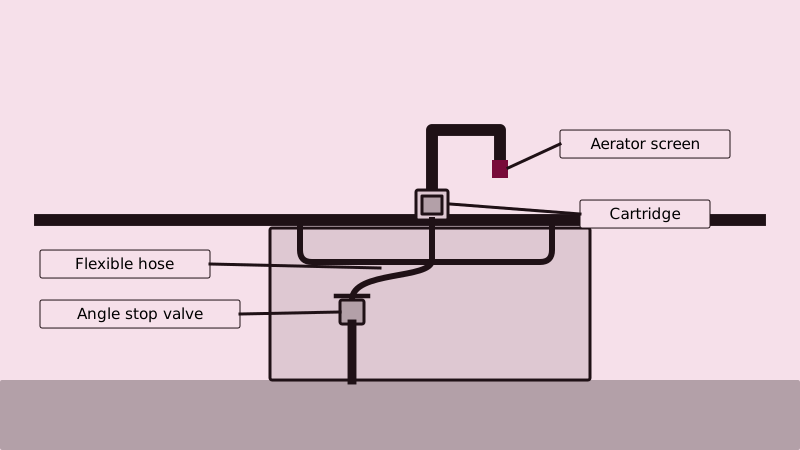
Imagine the kitchen faucet trickling while the shower down the hall roars. That contrast shows the supply into the house is healthy and the weakness lives at one fixture, which narrows the suspects to four: the aerator, the valve below the sink, the hose between them and the cartridge. Other fixture work, from faucets to disposal plumbing, sits in the same part of the site.
What does a weak flow at just one tap tell me?
It says the restriction sits between the wall and the spout of that faucet. The tip screen may be packed with mineral grit, the stop valve below may be half shut, a supply hose may be pinched, or the cartridge may be tired or gummed up. Normal flow elsewhere clears the main supply of suspicion.
Sort it with a quick comparison. Open hot alone, then cold alone. If only one side lags, hunt in that side's valve, hose or cartridge, or in the heater and hot piping when hot is the weak one. If both sides lag, the spout end is the likelier home.
Then try the other taps and the shower. If those are weak too, the issue is bigger, and why pressure drops throughout a house is the page to move to.
What is the way to unclog an aerator?
Twist the little screened cap off the spout, with a cloth around it so the finish survives. Rinse the screen and washers, soak them in white vinegar to loosen mineral crust, scrub with a soft brush, rinse again and screw it back on. A clogged aerator explains more weak sinks than any other fault, and the job takes minutes.
If the parts look damaged, take them to the hardware store, because thread sizes differ. Before refitting, let the tap flow briefly with the cap off to wash stray grit out of the line.
Scale builds quickly in hard water. The city of Whittier's own 2025 report gives total hardness averaging 250 mg/L, around 14.6 grains per gallon. Other suppliers serve parts of town, so your street's figure may differ, but in many homes a screen clogs every few months.
Is the valve under the sink or the hose to blame?
Often. Each faucet is fed by an angle stop and a flexible hose. A stop left partly open, or one that has corroded inside, chokes the flow, and a hose can kink behind the cabinet or fill with debris. Open the stop fully and straighten the hose first.
Move old valves slowly, since they may start to leak when disturbed, and keep a towel close. A hose with rust, bulges or crust should be replaced with a new braided one. A stop that will not budge or that drips is a small plumber job.
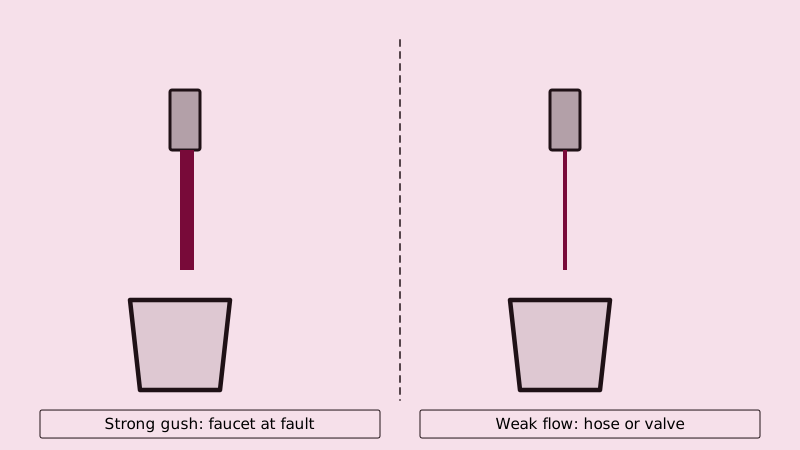
A neat test: unscrew the hose from the faucet and let it run into a bucket. A strong gush clears the hose and valve and puts the blame on the faucet. A weak flow puts it on the hose or the valve.
When does the faucet itself wear out?
Single-handle models depend on a cartridge, which can crack, wear or fill with grit and then give a weak or uneven stream, sometimes with a drip. A fresh cartridge often restores flow. Debris stirred up after a water shutoff or plumbing work can lodge inside it.
Find the faucet's model name on the body or under the sink so the cartridge matches. With an old faucet and scarce parts, replacing the whole unit may be simpler. Related reading: repairing a dripping sink faucet and what installing a faucet costs.
Pull-out and pull-down sprayers add a hose and a diverter that can restrict flow too. Weak spray with a strong stream suggests the sprayer head or its hose.
Could ageing pipes be starving the sink?
Sometimes, though they usually weaken several fixtures at once. Galvanized steel narrows inside as rust and scale accumulate, so flow fades over time, often worst at distant fixtures. Many postwar houses around here have it, and census data puts the median home in Downey at 1959 and in Norwalk and Pico Rivera at 1957.
Those numbers describe the housing stock, not your walls. Only an inspection shows what is inside yours. If several fixtures are weak in an older house, read about replacing galvanized pipe and whole-house repiping.
A tired pressure regulator can starve a house, or let pressure climb. The California Plumbing Code (608.2) caps pressure in homes at 80 psi. See adjusting a regulator valve and regulator replacement.
At which stage do I stop and call a plumber?
If the aerator, valve, hose and cartridge checks change nothing, if several fixtures are weak, if pressure fell right after plumbing work, or if a hidden leak or failing regulator is possible. A plumber reads pressure with a gauge and traces the restriction.
A sudden drop across the house plus a rising water bill can mean a leak; bills that climb with nothing visibly leaking lists checks to run. For a house-wide problem, low water pressure service describes a visit.
When you fill in the price request form, name the sink, say if hot, cold or both run weak, list anything else affected, and give the age of the house. Our other services are summarized at the home page.
Common questions
The kitchen is weak and the bathroom is fine. Why?
Each faucet has its own aerator, stop, hose and cartridge, so any of them can clog or wear alone. A pull-out sprayer adds a restriction of its own. Work through the aerator, the stop and the hose in that order, and if all are clear look at the cartridge or the faucet itself.
Only my hot water is weak at one sink. What gives?
Check the hot-side stop and hose, then the cartridge. If other hot taps are weak too, look toward the heater side, where sediment, a half-closed heater valve or an old galvanized hot line can be the cause. A gauge reading from a plumber narrows it down quickly.
Does hard water cause weak flow?
At the fixture, yes. Scale clogs aerators, showerheads and cartridges, and inside old steel pipe it narrows the bore. Whittier's city water averages about 250 mg/L in the 2025 report, so cleaning the aerator on a schedule pays. A softener cuts the buildup if it keeps coming back.
What pressure is too high for a house?
The California Plumbing Code puts the residential ceiling at 80 psi, and a regulator usually holds the supply under it. Thread a gauge onto an outdoor hose bib and you have your reading. Excess pressure wears fixtures and pipes, while too little makes taps weak, so the number tells you where to look.
Will a new faucet cure it?
Only when the old faucet is the culprit. A worn cartridge or corroded body restricts flow and a new faucet cures that. If the aerator is clogged, the stop is half shut or the whole house is weak, a new faucet changes nothing. Try the cheap checks first.
References
- City of Whittier 2025 Consumer Confidence Report (hardness)
- California Plumbing Code, section 608.2 (80 psi limit)
- Census ACS 2024 5-year estimates via Census Reporter (median year built, Downey, Norwalk, Pico Rivera)