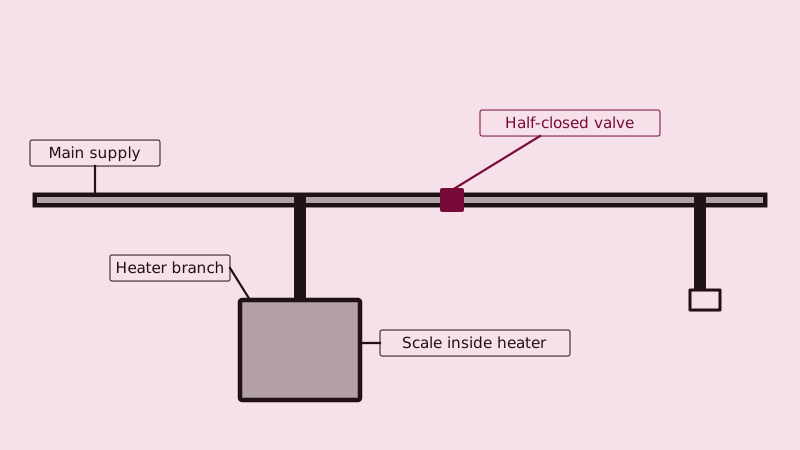
Start at a single sink, hot lever then cold. When only the hot stream is feeble, suspect the heater or the hot-side piping: a valve nobody opened all the way after the last job, scale plugging the outlet, or pipe rusted shut inside. When both streams are feeble, look at the incoming supply or the regulator. For tank trouble more broadly, go to water heater repair.
Is the weak flow coming from the heater or from the house?
Test one faucet and then a second in a far room. Hot weak everywhere with healthy cold implicates the heater and its piping. Cold sagging too turns attention to the supply: main valve, regulator, or blockage. One lone weak fixture most often has a clogged aerator or a tired cartridge.
The check itself takes two minutes:
- Fill a bucket from the cold tap and time it.
- Do the same with hot.
- Repeat at a faucet across the house in another bathroom.
- Note which results differ.
Slow cold water everywhere means starting at the meter and working inward, and the house-wide pressure causes are listed on their own page. A single sluggish shower is better handled through the shower pressure guide.
Does scale inside the heater choke hot water flow?
It can, and in Whittier it is a prime suspect. The city's 2025 report shows total hardness averaging about 250 mg/L, which the USGS ranks as very hard, and warming hard water makes minerals settle out as scale. That crust piles up along the tank bottom, over the element or burner, and flakes can break off and plug the outlet or fixture screens.
According to the USGS, scale narrows pipes and shortens equipment life. A tank full of sediment may pop or rumble when water boils beneath the layer. Warning signs include hot water that sputters, small grains in an aerator and a heater that takes longer to recover.
Flushing the tank is a plumber's job, and water heater service and repair explains what it involves. A tankless unit scales its heat exchanger and needs descaling, a job covered by tankless water heater service. To slow the buildup in the first place, see hard water scale prevention.
Might a half-shut valve or rusty pipe explain it?
Quite possibly. After earlier work, the shutoff on the cold inlet or hot outlet may have been left only partly open. Old galvanized hot lines also rust inside, so the passage narrows until only a thin stream gets through. A flexible connector kinked behind the heater does the same.
Look at the valves first, the cheapest fix there is. Both heater valves should be wide open, and with a lever-type ball valve, open means the lever sits in line with the pipe. If the hot line is galvanized and the weak flow came on gradually, the pipe itself may be restricted. Many postwar tract homes in this area still have galvanized sections, and galvanized pipe replacement shows what a fix looks like.
What if only one tap has weak hot water?
Blame the fixture first. A clogged aerator, a worn-out cartridge or a seized mixing valve can strangle the hot side while cold runs free. Take the aerator off, rinse out the grit (scale likes to block it), and check again. One shower weak only on hot often needs a new mixing cartridge.
When the problem follows you to every faucet in a bathroom, a shared branch line may be partly blocked. When it follows you to every faucet in the house, look back at the heater. Do not rule out a failed check valve or a broken diverter in a shower.
Are the relief valve and expansion tank involved?
Those two deal with pressure spikes, not feeble flow. Dripping or spitting from a relief valve means it is reacting to excess pressure or heat, so read that as a safety signal, not a weak-flow symptom. An expansion tank soaks up thermal swelling in a closed system, and when one fails pressure jumps. Neither accounts for a weak trickle.
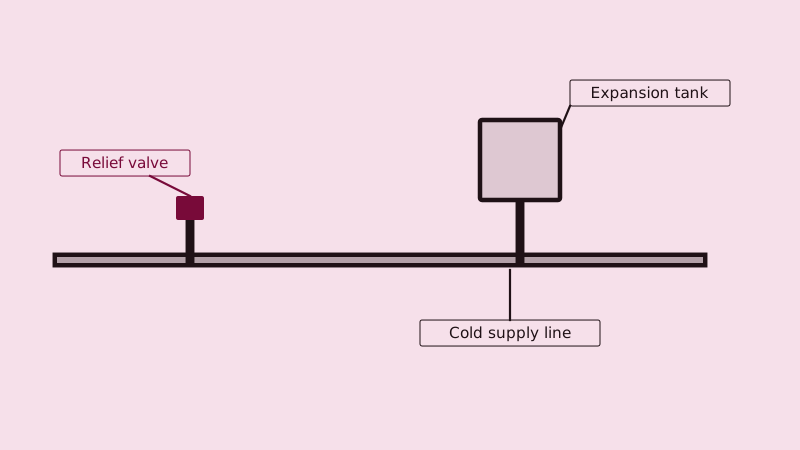
Still, both belong in the conversation if the house has pressure swings. If a relief valve discharges regularly, a plumber should see it; relief valve replacement explains the repair. A waterlogged or absent tank is the subject of expansion tank replacement. The plumbing code (section 608.2) puts the supply ceiling at 80 psi, and a hose-thread gauge from the hardware aisle will read yours.
Should the heater be replaced rather than repaired?
When a tank is old, corroded or full of sediment that will not flush out, new equipment is usually the better spend. A heater that has leaked, rusts at the fittings or struggles to keep up despite flushing is near the end. Repair makes sense when the cause is a valve, a connector or a clogged fixture.
Read the data plate instead of guessing the age. Tank heaters commonly run a decade or more, though water quality and upkeep shift that. If replacement looks likely, the replacement cost page sets out pricing factors, and since swapping a heater is permitted work, the water heater permit page deserves a look.
How do I book someone for weak hot water?
Tell us in the price request form which taps are weak, whether cold is also slow, and what heater you have and how old it is. A nearby plumber visits your Whittier-area address, hunts down the cause and commits the price to paper first. Gas and electric heaters are both fair game.
Gas odor near the heater is a walk-outside moment. Once outside, call SoCalGas at 1-800-427-2200. Gas piping and the relief valve discharge pipe are not do-it-yourself parts.
Prefer another starting point? The main page lists every service.
Common questions
Cold flows well, so why is hot weak?
With strong cold and weak hot, the blockage lives in the heater, a valve on it, or the hot piping. Likely suspects: scale at the tank outlet, a half-open valve, or galvanized pipe rusted nearly shut. A clogged aerator hits one fixture only, not the house.
Will flushing the tank help?
Sometimes, when sediment is to blame. Drawing off some water carries out loose scale and may bring flow back and quiet any popping. Hardened scale will not wash away. Check with a plumber before draining a very old tank, since stirring up the fittings can start a leak.
Is weak hot water a safety risk?
Weak flow alone is no hazard. A relief valve that leaks or discharges is a separate safety matter, as is any gas odor, and neither should wait. Gas odor means everyone out first, with the SoCalGas call made from the sidewalk.
Can a water pressure regulator cause low hot water pressure?
A single regulator feeds hot and cold alike, so a failing one weakens both streams. Weak hot with normal cold sends you back to the heater and its line. A gauge screwed to the hose bib settles it, and the number gives the plumber a head start.
What should fixing weak hot water cost?
The cause decides. A cleaned aerator costs almost nothing, a tank flush costs more, and replacing corroded pipe or a heater costs the most. Ask for a quote on paper that names the cause, and measure any heater price against the replacement cost guide.
References
- USGS, Hardness of water
- City of Whittier 2025 Consumer Confidence Report (State Water Board)
- California Plumbing Code, section 608.2 (80 psi limit)