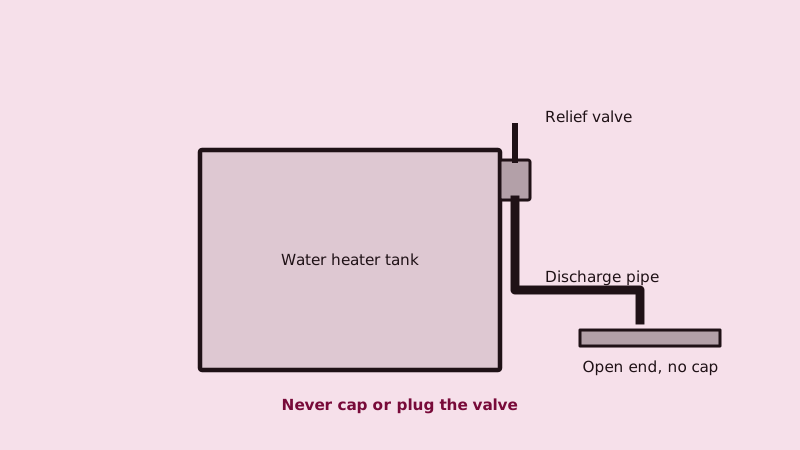
Change the T&P valve on a tank heater when it still leaks after a lever test, gives no flow when lifted, or has corroded stiff. What you never do is plug, cap or take it out, because it is the heater's last line of defense. Other heater trouble is sorted under water heater repair.
Why does a tank heater carry this valve?
It lifts on its own if the water overheats or tank pressure runs too high, venting out a discharge pipe, so the shell never ruptures. Standard valves lift at 210 degrees Fahrenheit or 150 psi, whichever arrives first, and carry a hand lever for testing.
Every storage tank is built with one. Makers state that the valve must stay in its opening and never be plugged, and that no shutoff may sit between tank and valve. A dripping valve is a clue worth chasing, never a nuisance to plug.
Gas and electric tanks use the same valve. Tankless heaters are built differently and have their own safeguards, so this page is about tanks.
How do you test the valve?
Lift the lever briefly, for as long as your heater's manual says, with the discharge pipe aimed into a bucket or at a drain. Water should rush out, and when you let go the lever should snap back and the flow should stop. Makers generally call for a test at least yearly, and some say twice a year.
Mind the water: it can scald. Keep hands, face and feet away from the outlet, and make sure the pipe points down. A valve that yields a trickle, nothing at all, or will not reseat has failed. Stop working the lever at that point, since each lift risks leaving it weeping.
Pick a time when you were going to replace the valve anyway. One that has sat untested for ten years often will not seal again afterward.
Why would the valve leak?
Four suspects: thermal expansion, high street pressure, a thermostat set too hot or stuck, and a tired seat. The cause matters, since a fresh valve cures only the last one, and the other three will wear out the replacement just as they did the original.
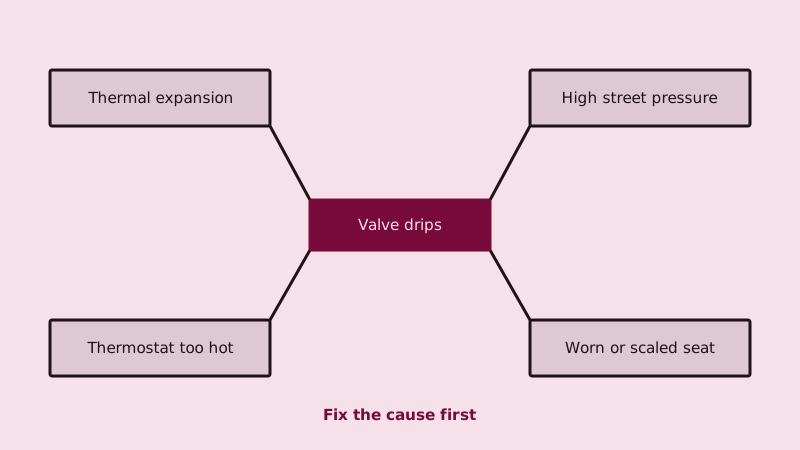
- Thermal expansion: where the system is closed, warmed water cannot expand into the supply line, so pressure builds. An expansion tank is the usual cure; see expansion tank replacement.
- High street pressure: The plumbing code's 80 psi ceiling (CPC 608.2) is what a regulator holds supply pressure under. Read about regulator replacement.
- Thermostat or element trouble: the water really is overheating, and the valve is behaving correctly. Switch the heater off, then bring in a plumber.
- Worn seat: scale props the valve open a hair. Whittier's 2025 city report shows hardness averaging 250 mg/L, around 14.6 grains in a gallon, which makes scale a common cause here.
If the discharge pipe is hot and steaming, stop the heat source, close the cold feed, and phone for help.
At what point should the valve be swapped?
Replace it when it leaks after a test, delivers no flow, shows heavy corrosion, or when the tank is being replaced anyway. Some manufacturer guidance asks for a professional inspection every three years. Because the part costs little next to a tank, plumbers often change it whenever they service a heater.
The replacement must suit the tank: matching temperature and pressure rating, discharge capacity at least equal to the heater's input rating, and a pressure setting no higher than the tank's 150 psi working pressure. The ratings are stamped on the valve and listed on the heater's tag, so buy the same model or one the heater's maker lists.
Water or rust around the bottom of the tank means the heater itself is failing, a separate issue treated in water heater lifespan.
Can a homeowner replace the valve?
Many can, provided they are comfortable cutting power or gas, partly draining the tank and working around hot water. The steps are short. The danger is firing up an empty tank or running one with no valve at all. If any of that worries you, call a plumber.
The usual sequence, per manufacturer guidance:
- Cut power or gas, then close the cold supply.
- Run a few gallons off until the level drops under the valve, then disconnect the discharge pipe.
- Unscrew the old valve counterclockwise and clean the threads.
- Wrap thread tape on the new valve and snug it in without cranking.
- Reattach the discharge pipe, refill with a hot faucet open somewhere to push out air, bring power or gas back, and test the lever.
Never restore power unless the tank is full and a relief valve is fitted. If the valve sits against a gas fitting or is scale-locked, stop and hire a plumber. Contractors with a California license do permitted work, so ask your city whether this particular job needs paperwork.
For the permit side of a whole heater swap, the water heater permit page fills in the picture.
What are the rules for the discharge pipe?
Carry water from the valve to a safe spot and end in an air gap, never tied straight into a drain. It should match the valve outlet or be larger, hold no valve, have no threaded end, and drain completely. Local rules vary, so check with your city.
Common practice ends the pipe a few inches above the floor, over a drain pan, or outdoors, inside the heater's room. A pipe that is capped, threaded, reduced or absent is a defect to correct on the same visit, so point it out to the plumber.
For a written price covering valve, discharge pipe and any expansion tank, request a quote.
Common questions
What should a new valve set me back?
The part is inexpensive and the labor is a short visit. We have no local number we can source. Ask the plumber to put the part, the labor and any call-out fee on paper. Bundling it with an expansion tank or heater replacement is often cheaper than a separate trip.
Is a little dripping acceptable?
An occasional drip while the heater runs can be thermal expansion, but a steady one is not normal. It signals high pressure, high temperature or a worn valve. Ask a plumber to read line pressure with a gauge before replacing anything, since a new valve will drip as well if pressure is the cause.
Is it ever okay to plug a valve that leaks?
No. Capping or plugging it removes the one safeguard and can turn the heater into a hazard. The discharge line has to stay open and the valve free to act. When it drips, find the cause and fix it or swap the valve.
How frequently should you try the lever?
Many manufacturers call for at least a yearly test, and some say twice a year; check your manual. Lift it as your manual directs, confirm water flows into the discharge pipe and make sure the valve shuts fully afterward. If it fails, replace it.
This guide is one of many on plumber in Whittier.