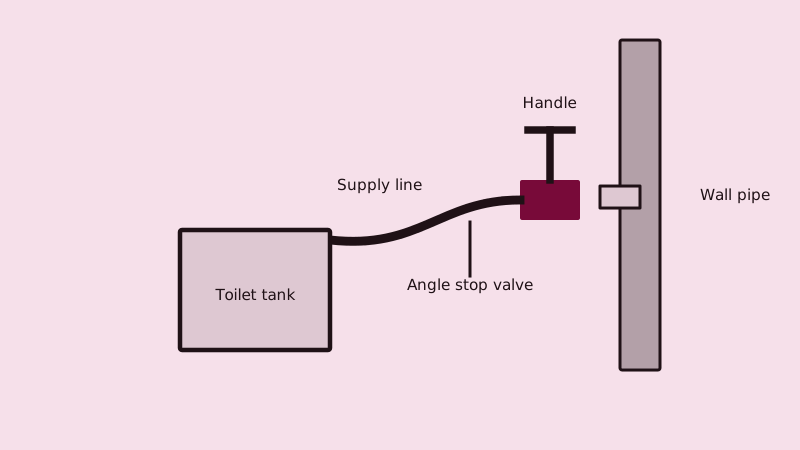
The small angled valve behind a toilet, called an angle stop, can usually be repaired or swapped in under an hour when it drips at the stem, sticks or fails to shut. The snag is the water supply: if the valve will not shut, the whole house has to be turned off first. For faults inside the tank and bowl, go to the main toilet repair guide.
Is the valve behind the toilet really the culprit?
Check for moisture at the stem, a crust of green or white around it, a handle that refuses to budge, or a tank that keeps filling after the valve is closed. A damp patch on the cabinet floor or wall below the supply line often begins here.
Three signs, three diagnoses:
- Drip behind the handle: the packing nut or washer has worn, and a slight tightening may end it.
- Frozen handle: scale and age. Forcing it risks snapping the stem.
- Flow continues when closed: the washer or seat inside is gone, so the valve is finished.
Slide a paper towel along the body and both connections. A drip at the supply-line nut points to a loose or tired connector, which costs less than a valve.
Can you fix a leaking angle stop instead of replacing it?
Sometimes. A weep from behind the handle may stop after a small twist of the packing nut. Water at the supply connection needs a firmer nut or a fresh line. If water still escapes or the valve does not shut completely, replace it. Rebuilt valves rarely hold up.
Quarter-turn ball valves cost little and outlast the old multi-turn type, so plumbers usually replace rather than rebuild. Cycle a new one closed and open twice a year to keep it from locking up.
Unsure which nut is which? Photograph it and take the picture to the store, or call a plumber. Cranking down a packing nut is a classic way to crack the valve body.
How is a toilet shutoff valve replaced?
Shut the house main, flush till the tank runs dry, undo the supply line, take the old valve off the wall pipe and thread or clamp on a new one matched to the pipe. Compression valves suit copper and some plastic. Soldered copper needs a torch and a plumber. Reopen the water slowly and watch the joints.
The wall pipe decides the method:
| Wall pipe | Typical method | Who does it |
|---|---|---|
| Copper stub | Compression valve | A capable DIYer |
| Copper, needs soldering | Cut and sweat a new valve | A plumber |
| Galvanized steel | Thread on a new valve, often with new pipe | A plumber |
| PEX or CPVC | Push-fit or crimp valve | Either, with the right fitting |
Old galvanized stubs can snap as the old valve turns, converting a ten-minute swap into wall work. Scale builds up inside these valves faster with hard water, and Whittier's city supply averaged about 250 mg/L total hardness in its 2025 report.
What does a shutoff valve repair cost?
One 2026 cost guide lists shutoff valve replacement at roughly $75 to $150 as an add-on, and supply lines at $15 to $40 apiece. A trip made only for the valve brings the plumber's call-out charge, and a stubborn or soldered valve costs more. Get the figure in writing first.
The bill grows when the house main refuses to close, since the main would then need replacing before anything else can happen. Say so when you phone, and note where the main is. Faucet installation pricing shows the same add-ons in context, and hourly plumber rates covers labor.
What if the valve refuses to close?
Cut the supply at the house main, then call a plumber. Stop forcing the valve, and don't wait for it to give out. Learn where your main sits before you need it: often in the meter box, by the front spigot, or where the pipe emerges from the foundation.
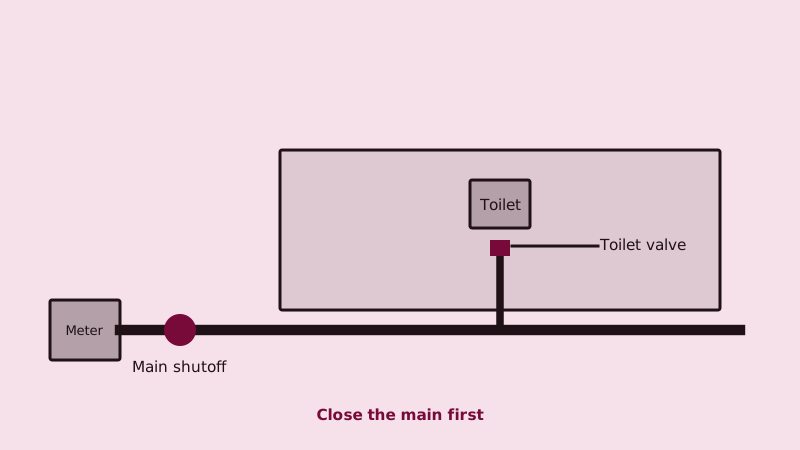
When water is already running, close the main first and deal with the valve second. In 1950s homes around Whittier, Downey and Norwalk, a main untouched for decades may be seized too. Have the plumber test it and replace it if needed, because that one valve protects every future repair. Census figures put the median Downey home at about 1959 and the median Norwalk home near 1957.
For a bowl that is overflowing, turn off the valve behind the toilet, or open the tank and hold the float up to stop the fill. A bowl that keeps rising belongs to overflow tube repair and the clogged toilet plumber.
Which jobs should go to a plumber?
Hire one when the valve is frozen, the wall pipe is galvanized steel or soldered copper, the leak originates inside the wall, or you are uneasy about killing the house water. A plumber carries fittings for each pipe type and finishes with a proper leak test.
Replacing the toilet's supply line during the same visit makes sense, and so does checking the stops under the sinks. Old multi-turn valves tend to fail as a set. To get a price on paper, send a request. The Rio Hondo Plumbing main page explains how visits get arranged.
Common questions
What makes a toilet shutoff valve leak?
Typically a tired packing nut or washer behind the handle, or a supply-line nut that is slack or worn out. Try a small turn on the packing nut first. A valve that still weeps then should be replaced, and one that leaks while shut is finished.
Is replacing it a homeowner job?
Yes, if you can shut the house main and the wall pipe is copper taking a compression fit, or PEX. If the pipe is galvanized or needs soldering, call a plumber. Test for leaks before you walk away, and look again the next day.
How many years does a shutoff valve last?
No fixed lifespan is one we can cite. Multi-turn valves tend to seize or leak with age, especially in hard water, and quarter-turn ball valves tend to last longer. Any valve that has gone stiff, weeps, or stops short of fully closed should be replaced.
Should the valve sit fully open?
Yes. Leave it fully open, then back it off a quarter turn if it feels jammed at the end of travel. Working it closed and open once a year keeps it free. A toilet that refills sluggishly may be starved by a half-open valve.