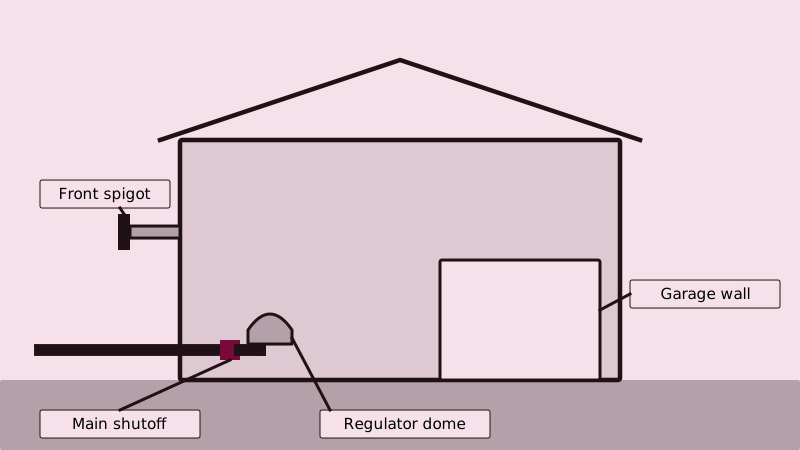
Follow the main water line from the street into the house. The regulator is a brass dome roughly grapefruit-sized, and it usually sits on that line right after the main shutoff. Likely spots: outside beside the front spigot, on a garage wall, or beneath the floor. Plenty of houses never had one. If your readings are off, low water pressure service explains the next move.
Where do I look first for the regulator?
Start at the main shutoff valve, because the regulator almost always sits within a few feet of it on the same pipe. In slab-on-grade tract houses the entry point is often on the front wall under or beside the hose spigot, or inside the garage on the wall nearest the street. Raised-foundation houses may hide it under the floor.
Bring a flashlight and look for a squat, dome-shaped body, usually brass or bronze, with a threaded cap and an adjustment screw or bolt on top. It has an arrow cast on it showing the flow direction. Pipe goes in one side and out the other, and a short stub often rises up to a gauge or plug.
Places it tends to hide:
- A low spot on the garage wall near the heater or the washer hookup.
- The outside wall by the front spigot, occasionally inside a small box.
- Crawl space under the kitchen or at the front, nearest the street.
- A side yard, in a lidded box set at ground level.
How do I recognize one on sight?
Picture a brass bell or dome with a flared base, a bolt or screw head on top, and a pipe fitting at either side. Sizes run from fist to cantaloupe. The cap holds a spring, and the base holds a diaphragm and valve seat. Some have a built-in strainer plug on the bottom.
Do not mistake it for the shutoff, which is only a handle or wheel mounted on the pipe. Also separate it from an expansion tank, a small metal tank hung near the water heater, and from a hose-bib vacuum breaker. If you see a bell shape with an adjustment bolt, you have found it. A photograph helps a plumber confirm from a distance.
What if nothing like that turns up?
Walk around the whole house, because the main might come in at the rear, at a side wall or inside a closet. Inspect the garage and any sink cabinet against an outside wall. Some homes have no regulator because the street pressure is already within code, or because an old one was removed.
A gauge settles the question. Thread a pressure gauge onto an exterior spigot, confirm no one is running water, and read the dial. The California Plumbing Code limit is 80 psi, so a higher reading means you need pressure control, and a plumber can install one. For pricing, see installing a pressure regulator.
Is the regulator in the utility's meter box instead?
Sometimes. Some water suppliers put pressure control at the street or in the meter box, and those parts belong to them. Look at the meter box lid. If the box holds nothing but a meter and a shutoff, a regulator, if one exists, is on the owner's side or missing. The utility named on your bill can tell you.
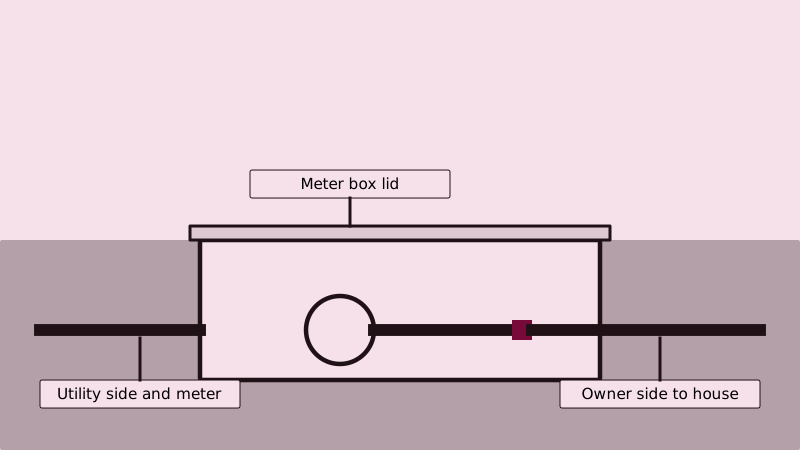
Whittier has the city system and other suppliers by address, so confirm which one serves you. City of Whittier water customer service is at (562) 567-9530. Do not open a meter box yourself, because the supplier owns the equipment. Plumbers work from the meter inward, which is where a regulator becomes the owner's job.
Why does location matter for hillside and tract homes?
The entry point tells you where to look, and it varies with how the house was built. Postwar tract homes dominate here, since the median build year is 1959 in Downey and 1957 in Norwalk and Pico Rivera, and they often have front-wall or garage entries. Larger lots in La Habra Heights and Hacienda Heights may have longer runs from a street meter.
Slopes change the picture. Gravity hands a house downhill more static pressure than a neighbor at the crest, so a working regulator earns its keep on a grade. If your home sits below the street, expect the line to drop to the house in a trench. The plumber can trace it.
Is my regulator still doing its job?
Attach a gauge. A good regulator holds a steady number below the code limit, much the same in the evening and at dawn. Signs of failure include a gauge that creeps upward when water is not in use, a bang when valves close, dripping from relief valves, or weak flow when you open a tap.
Noise gives clues. Water hammer, discussed in water hammer sound, can follow a failed regulator. A gauge that climbs when nothing is running hints that the seat leaks and pressure is stacking up, which punishes fixtures. Next steps live in causes of weak flow and setting the regulator valve.
Is this something an owner can tune or swap?
Tuning is feasible for a careful owner with a gauge: slacken the lock nut, make small turns of the screw, and read the gauge after each. Swapping one means cutting the main line, matching fittings and checking permit rules, so many people bring in a plumber.
Anything needing a permit in California goes to a contractor holding a California license. The City of Whittier Building and Safety Division, (562) 567-9320, or your own city's counter can say whether it applies. For replacement work and costs, read regulator replacement.
Common questions
Why do some houses not have a regulator?
Older homes, or homes in areas where the street pressure is already moderate, may never have had one. Others had one removed when it failed. The plumbing code limits pressure at 80 psi, so a gauge reading above that is a sign you need one. A plumber can confirm after testing.
Is the regulator the same as the pressure tank or the expansion tank?
No. A regulator reduces incoming pressure, and it takes the form of a dome-shaped valve on the incoming pipe. An expansion tank is a little vessel beside the water heater that soaks up thermal expansion. Each solves a different problem, and the two are often installed together on a home with a closed system.
What is a regulator's service life?
It varies by model, water quality and pressure, and they eventually wear out. There is no fixed lifespan, and hard water scale can shorten it. Whittier's 2025 report shows hardness averaging 250 mg/L. Read the pressure occasionally instead of waiting for symptoms.
Who can examine mine?
Tell us what you have noticed through the price request form, with a photo of where the main enters if you can. A local plumber follows, and the written quote lists testing and parts. That is enough for a good first estimate.
For the wider picture, start with Whittier plumber.