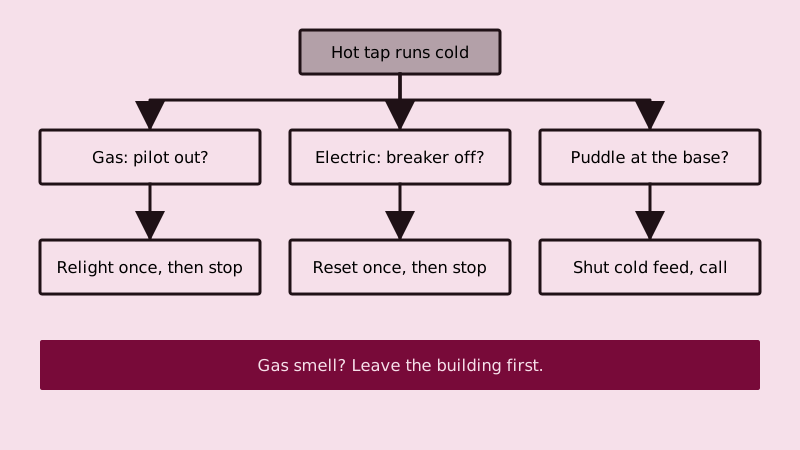
Nearly every cold-tap morning has one of five causes: the pilot blew out, a breaker flipped, an element or thermostat wore out, the thermocouple quit, or the tank shell failed. Ten minutes beside the heater usually narrows it to one. Should a reset fail, the water heater repair pages describe what a service call includes.
What turns a hot tap cold in the first place?
A gas unit goes cold when its pilot dies, its thermocouple fails or the gas stops flowing. Electric ones stop when a breaker trips, an element burns out or a thermostat fails. A leaking tank or a day of heavy use can also leave you with nothing but cold. Symptoms point at the cause, so look before touching.
A short walk-around:
- Puddle at the base? Suspect the tank itself.
- Pilot dark, or a blinking code on the control? Gas side.
- Lights flickered or a breaker flipped lately? Electric side.
- Lukewarm instead of cold? One element, or a thermostat turned low.
- Only one faucet affected? The heater may be fine and a single cartridge worn.
Many Whittier houses park the heater in a garage closet, a spot where lint, dust and drips pile up. Take a flashlight and look without poking.
Gas heater, no hot water: where do I start?
Begin at the pilot window. No flame means the burner has nothing to ignite it. Next to the flame sits a thermocouple, a small probe that tells the gas valve to stay open as long as it senses heat. A weak one lets the pilot die again soon after each relight. A paused gas supply or a clogged burner can mimic it.
Wikipedia describes the thermocouple as a fail-safe: with no flame it cools and the valve shuts, so raw gas is not released. That explains why a bad one makes a heater quit instead of leak. Swapping it is covered under thermocouple replacement.
Relight once, using the steps on the heater's own label. A flame that holds means you are done. One that dies again means stop. Electronic ignition models skip the pilot altogether and flash a code.
Gas in the air changes everything. Go outside first. After that, SoCalGas is reachable at 1-800-427-2200, while 911 handles any immediate danger to people. Nobody relights a pilot or flips a switch while the smell lingers.
Electric heater, no hot water: what fails?
Open the electrical panel and look for a tripped breaker, since an electric tank has its own heavy circuit. One reset is reasonable. A second trip means leave it alone. After the breaker, suspects are the upper and lower elements, the thermostat, and the red high-limit button beneath the thermostat cover.
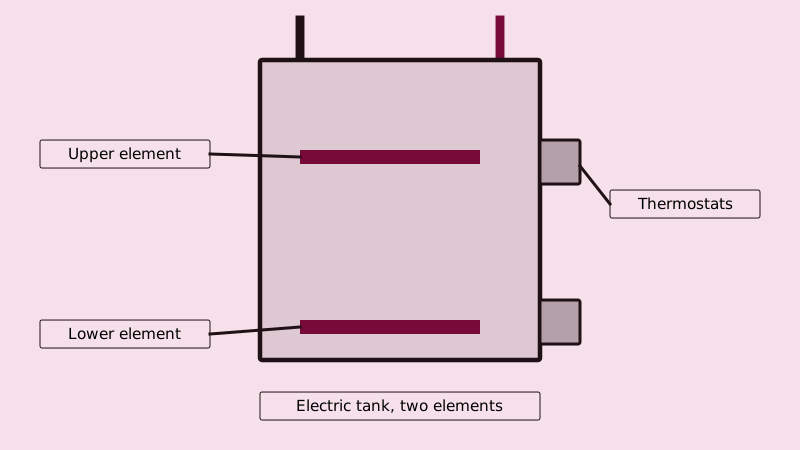
Kill the breaker before any cover comes off, because water and household current together are dangerous. Testing and swapping parts belongs to someone at ease with electrical work. What a replacement involves is described under heating element replacement.
Patterns help with the guess. A shower that runs hot briefly and then cold often means the lower element. Tepid water points to the upper element or thermostat. Nothing at all can mean a tripped limit switch or no power reaching the unit.
What if the heater runs but the faucets stay cold?
More detail sits in heater switched on, still no hot water. Common reasons include a dead element or burner, a thick layer of sediment, a snapped dip tube that lets cold water short-circuit to the outlet, or a faulty valve elsewhere that bleeds cold water into the hot line.
Sediment matters here. The City of Whittier's 2025 report lists hardness averaging 250 mg/L, which is hard water, and minerals settle in tanks and crust elements. Crusted elements burn out sooner and the tank loses capacity.
One cold shower with hot taps elsewhere points to the cartridge. See shower no hot water.
What can a renter or condo owner do with no hot water?
Tenants normally leave the heater alone. Report it to whoever manages the building by email or letter, dated, and keep your own record. In a shared mechanical room or a central boiler, repairs belong to the building owner, and nobody else should be opening those enclosures.
If the owner stalls, the city or county housing office can explain a tenant's options. Condo owners with their own tank pay for the repair but should read association rules first, since many buildings restrict who may work in utility closets.
A plumber sent by the owner is the right person to trace a fault in a shared system, and we can arrange a visit for a household that owns the equipment.
When should I stop troubleshooting and treat it as urgent?
Call it urgent if the tank leaks, you smell gas or burning, or the tank rumbles and hisses. Without those signs, a relight or breaker reset often brings heat back the same day. When neither works, a plumber finds the fault; the urgent route is emergency water heater repair.
If the tank is leaking, shut the cold-water valve feeding it, the gas control or breaker turned off, and a visit booked.
Do not crank the thermostat to compensate, because, as Wikipedia points out, skin can be scalded in about five seconds once water reaches 140 degrees F.
Fix this one, or put in another?
One dead part in a healthy tank deserves a repair. A tank that weeps, has rusted through, is simply old or keeps throwing new faults is a replacement candidate, and the money side is on water heater replacement cost. Weigh the repair bill against the tank's age, and ask for both numbers before deciding.
Common questions
Do plumbers dislike tankless heaters?
Many dislike badly matched installs, not the technology. A tankless unit needs the correct gas line, a suitable vent and periodic descaling, and trouble usually comes from skipping one of those. With hard water, scale is the bigger concern. A well sized unit does well, and a poorly sized one disappoints.
Is the repair quick?
A pilot or a breaker is minutes. A thermocouple or an element is a morning or an afternoon at most, depending on parts. A full replacement takes longer and involves a permit, so it is usually planned as its own visit unless the tank is leaking badly.
Can I troubleshoot a Rheem or another brand myself?
Yes, up to a point, on any brand: pilot or ignition light, error codes, breaker and thermostat setting. The label on the heater carries the maker's own steps. Gas piping, wiring and the tank itself go to a contractor. Photograph the data label before you call, because it lists the model and age.
Why does the kitchen have hot water but the shower does not?
Usually the shower valve rather than the heater. A worn mixing cartridge or a clogged valve can leave the shower tepid while other taps run hot. That diagnosis does not require touching the heater, and the fix tends to be much smaller than a heater job.
What details should I give when I ask for a price?
Say gas or electric, the rough age, where it sits, symptoms and anything you tried. That shortens the visit. Put it in the price request form. Elsewhere on the site, the Rio Hondo Plumbing home page lists other work we line up.